
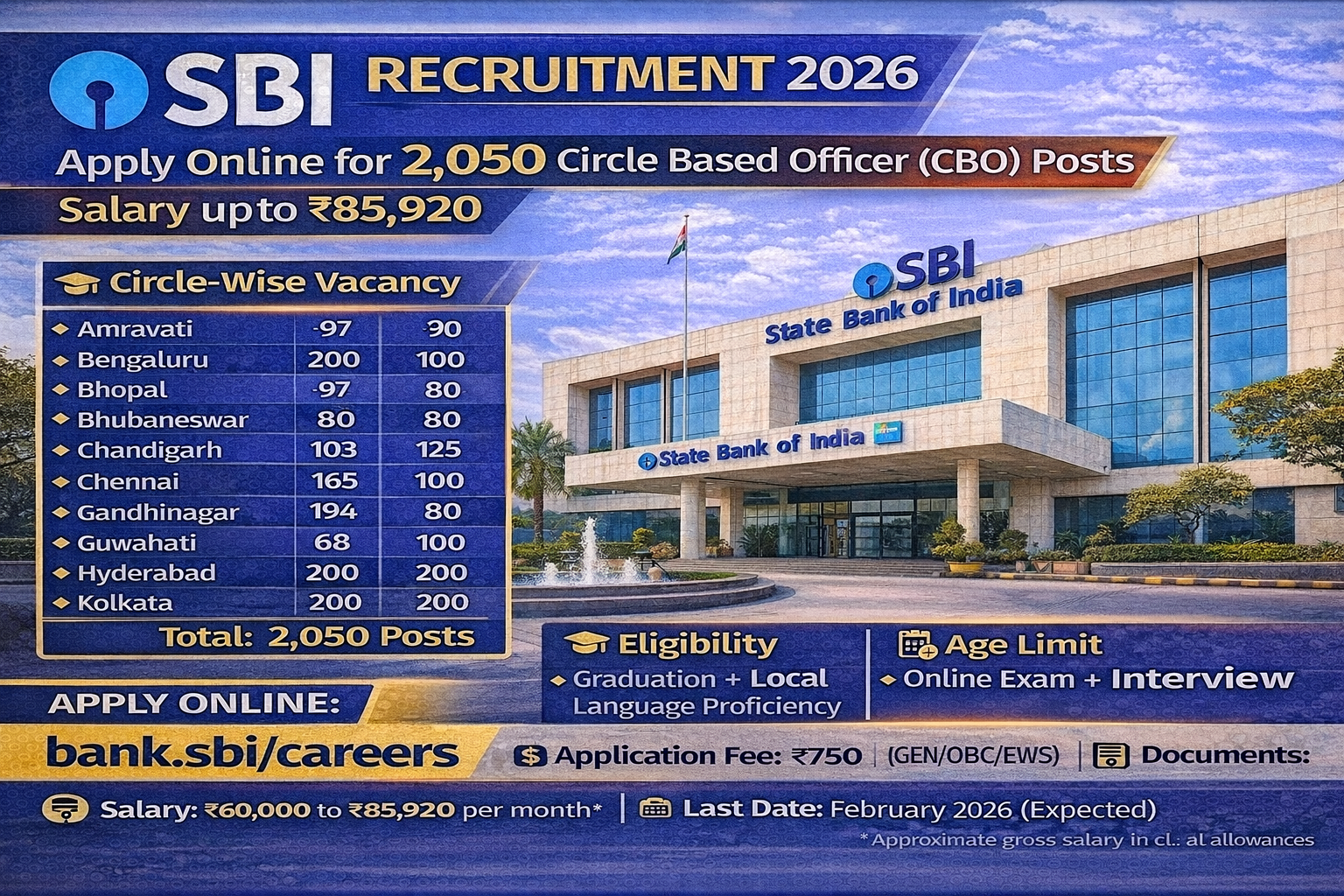
The wait is finally over for banking aspirants across India. The State Bank of India (SBI) has officially dropped the notification for the Circle Based Officer (CBO) Recruitment 2026. With a staggering 2,050 vacancies, this is not just another job opening; it is arguably the most significant direct officer-level entry opportunity in the public banking sector this year.
If you hold a graduation degree and dream of a role that offers a high salary (₹60,000+ in-hand), unmatched job security, and a clear promotion path, you need to stop scrolling and start reading.
While many websites will give you the basic dates and fees, this guide is your strategic blueprint. We will dissect the notification, decode the hidden patterns of the selection process, and provide a preparation roadmap that 90% of candidates ignore.
Why the SBI CBO Role is a “Career Launchpad,” Not Just a Job
Before we dive into the numbers, let us understand why this specific recruitment is causing a frenzy. Most bank exams (like Clerk or PO) have a long probation period and a generalist training phase. The SBI Circle Based Officer role is different.
-
Direct Local Connect: Unlike a Probationary Officer (PO) who can be transferred anywhere in India, a CBO is posted within a specific “Circle” (State/Region) of your choice. You get to build your career without uprooting your family.
-
Higher Remuneration for Experience: While the official pay scale starts at ₹48,480, the perks (Allowances, HRA, DA, and CCA) push the in-hand salary to nearly ₹75,000 in metro circles and around ₹60,000 in rural areas.
-
Fast-Track Growth: SBI treats CBOs as specialized officers. The learning curve is steep, and the promotion cycle to Middle Management Grade Scale-II (MMGS-II) is faster compared to clerical promotions.
Detailed Vacancy Breakdown: Which Circle is Your Best Bet?
The total of 2,050 vacancies is spread across the country. However, a smart candidate looks beyond the total number. They look at the competition ratio and language feasibility.
SBI has released a circle-wise breakup. Here is the original data followed by our analysis:
| Circle (Region) | Vacancies | The “Hidden” Advantage |
|---|---|---|
| Bengaluru | 200 | High salary due to HRA, but high competition. |
| Kolkata | 200 | Moderate competition, good for candidates from East India. |
| Lucknow | 200 | High volume of applicants from UP; requires high cut-off. |
| Maharashtra | 194 | Covers Pune, Nashik, etc. Lower competition than Mumbai Metro. |
| Mumbai Metro | 143 | Highest cost of living but highest in-hand salary. |
| Chennai | 165 | Requires Tamil proficiency; great for locals. |
| Jaipur | 103 | Moderate competition. |
| Chandigarh | 103 | Covers Punjab, Haryana, Himachal. |
| Bhopal | 97 | An underrated choice; often has a lower cut-off. |
| Amravati | 97 | Vidarbha region specific. |
| Hyderabad | 80 | Requires Telugu/Urdu. |
| Bhubaneswar | 80 | Requires Odia. |
| New Delhi | 76 | Extremely competitive because of the national capital status. |
| Ahmedabad | 194 | Requires Gujarati. |
| Guwahati | 68 | Covers entire North East; requires local language. |
| Thiruvananthapuram | 50 | Requires Malayalam; lowest vacancy but very localized competition. |
Expert Analysis: If you are a general category candidate from a Hindi-speaking state, do not blindly flock to Lucknow or Bhopal. The cut-off there is historically higher. Consider circles like Chandigarh (if you have basic Punjabi/Hindi) or Maharashtra (Non-Metro) , where the ratio of vacancies to population density is slightly better.
Critical Dates & Timeline for SBI CBO 2026
Time is your most valuable asset. Do not wait for the “last week” to apply. Here is the official window:
-
Application Start Date: January 2026
-
Last Date to Apply (Deadline): February 2026
-
Admit Card Release: Last week of February 2026
-
Online Exam (Tentative): March / April 2026
-
Interview & DV: May / June 2026
Note: SBI is known for sticking to its tentative schedule. Prepare as if the exam is in late March 2026.
Eligibility Criteria: The “Gotcha” Rules You Must Know
Most candidates check the “Graduation” box and move on. However, SBI CBO 2026 has two specific pitfalls:
1. The Local Language Clause (The Deal Breaker)
Unlike RBI Grade B or IBPS PO, SBI CBO requires proficiency in the local language of the circle you apply for.
-
Example: If you apply for the Chennai circle, you must be able to read, write, and speak Tamil. A certificate from the school board (Class 10 or 12) that you studied Tamil as a subject is the best proof.
-
Consequence: If you clear the exam and fail the language proficiency test at the time of Document Verification (DV), your candidature will be cancelled on the spot.
2. Age Relaxation Nuances
-
Minimum: 21 Years
-
Maximum: 30 Years
-
Relaxation: SC/ST (5 Years), OBC-NCL (3 Years), PwD (10 Years).
Crucial Tip: For OBC candidates, ensure your Non-Creamy Layer (NCL) certificate is valid as of the application date. SBI is very strict about the format.
Salary Structure: Breaking the Myth of “Just 48,480”
Let’s talk money. The notification mentions a pay scale of ₹48,480 – ₹85,920. But your bank account will never see just ₹48,480.
Here is the breakdown of the Approximate Monthly Salary for an SBI CBO in a metro city:
-
Basic Pay: ₹48,480
-
Dearness Allowance (DA): ~₹20,000 (Updated every quarter based on CPI index)
-
House Rent Allowance (HRA): ~₹10,000 (Varies based on city type – Metro/Urban/Rural)
-
City Compensatory Allowance (CCA): ~₹2,000
-
Other Perks: Travel allowance, newspaper reimbursement, medical benefits.
Total In-Hand (Metro): Approx. ₹72,000 – ₹75,000
Total In-Hand (Rural): Approx. ₹58,000 – ₹62,000
Plus, you get a government-employee-specific mediclaim policy for your family, a concessional loan policy for housing and vehicles, and a pension under the NPS (National Pension System) where SBI contributes 14% of your basic pay.
The Selection Process: A Two-Pronged Attack
The selection is not just about a computer test. It is a two-stage war.
Stage 1: Online Written Examination (160 Marks)
This is a dual-format test:
-
Objective Test (120 Questions / 120 Minutes): 120 Marks (Negative marking of 0.25)
-
Descriptive Test (2 Questions / 30 Minutes): 50 Marks (Qualifying in nature)
Stage 2: Interview (20 Marks)
Once you clear the written exam, you face the Interview Panel. The final merit list is prepared based on:
(Written Exam Score out of 120) + (Interview Score out of 20) = Total (Out of 140)
The Game Changer: The interview carries 20 marks. In a tight race where two candidates have 95/120, a single good interview (15/20 vs 10/20) can swing the selection. The interview is NOT just a formality.
Exam Pattern Deep Dive (Subject-wise Strategy)
To beat the competition, you need to know which subjects matter.
Section 1: Banking Knowledge (40 Marks – High Weightage)
This is the king. 40 marks specifically on Banking.
-
Topics: CASA ratios, Repo Rate, Reverse Repo, Marginal Standing Facility (MSF), Basel Norms (III & IV), Priority Sector Lending (PSL), NPCI products (IMPS, NEFT, RTGS), Latest RBI circulars (2025-2026).
-
Strategy: Read the RBI Monetary Policy report monthly. Do not rely on 2-year-old GK books.
Section 2: English Language (30 Marks – Low but Tricky)
-
Topics: Reading Comprehension (Banking themed), Cloze test, Para jumbles.
-
Strategy: Unlike other exams, SBI’s English section is of moderate difficulty but time-consuming. Practice speed reading.
Section 3: General Awareness (30 Marks – The Differentiator)
-
Topics: Not just static GK. Focus on Financial Awareness (Budget 2026, UN indices), Banking Terms (NPA, SMA, LTV ratio), and Sports/Appointments related to the Banking sector.
-
Strategy: Read “The Economic Times” or “Mint” daily for 15 minutes.
Section 4: Computer Knowledge (20 Marks – The Free Scorer)
-
Topics: MS Office shortcuts (Ctrl+S, Ctrl+P), History of computers (Generation), Networking (LAN, WAN, MAN), Security (Firewall, Malware, Phishing).
-
Strategy: This is your easy marks. Do not lose any here. Memorize the shortcut keys and abbreviations (HTML, HTTP, URL).
Section 5: Descriptive Test (Letter & Essay)
You will get 30 minutes to write:
-
Letter Writing (15 Marks): Usually a formal letter to the Branch Manager regarding a banking issue.
-
Essay (10 Marks): Topics like “Digital India and Rural Banking” or “Role of AI in Banking.”
Critical Warning: The descriptive paper is qualifying, meaning if you score below the cut-off (usually 20 marks), your objective paper is not evaluated. You must clear this hurdle.
How to Apply for SBI CBO 2026 (The Safe Way)
Do not rush the application. SBI servers crash on the last day. Follow this checklist:
-
Go to
https://sbi.co.in/web/careers(Never click on phishing ads). -
Click on “Recruitment of Circle Based Officer 2026”.
-
Registration: Use a valid email and active mobile number. OTP verification is mandatory.
-
Photo & Signature: The photo must be white background, taken in the last month. The signature should be on white paper with a black pen.
-
Language Proof: Upload your Class 10 certificate (if it has your local language) or a certificate issued by a recognized board.
-
Fee Payment: General/OBC pay ₹750 via UPI/Debit/Credit. SC/ST/PwD get a free application (zero fees).
-
Final Submission: Click “Submit” and wait for the “Application Completed” screen. Save the PDF.
Document Checklist for DV (Don’t Wait for the Result)
Candidates often clear the exam but fail Document Verification (DV) because they don’t have the right papers. Keep these ready today:
-
Photo ID: Aadhar Card, Voter ID, or Passport.
-
Age Proof: SSLC/10th Marksheet.
-
Graduation: All year-wise marksheets and degree certificate. (If you are in the final year, you are generally not eligible unless you have passed before the application date).
-
Caste Certificates: SC/ST/OBC with the NCL clause (OBC).
-
Language Certificate: Crucial for CBO.
-
Ex-Servicemen Documents: If applicable.
-
PwD Certificate: Issued by a government medical board.
30-Day Preparation Strategy (High-Intensity)
Assuming the exam is in 30 days, here is your weekly plan:
-
Week 1 (Foundation): Only Banking Awareness and Computer basics. Do not touch GK yet. Build your fundamentals of APR, Banking products, and Financial terms.
-
Week 2 (Practice): Start English. Read 2 editorials daily (The Hindu). Attempt 2 mock tests in the morning.
-
Week 3 (GA & Descriptive): This is your General Awareness week. Focus on “Current Affairs of the last 6 months.” Practice writing one Essay and one Letter daily on a sheet of paper to improve handwriting speed.
-
Week 4 (Revision & Mocks): No new topics. Re-solve the 10 mocks you took in Week 2 and 3. Analyze why you got an answer wrong. Was it lack of knowledge or negative marking? Work on accuracy.
Frequently Asked Questions (F.A.Q.)
Q1. I am a B.Com graduate. Is this role better than CA?
A: CA is a technical qualification. SBI CBO is a management role. If you want a stable 9-to-5 with holidays, CBO is better. If you want higher salary with stress, pursue CA.
Q2. Can I choose my posting city within the circle?
A: No. Within the circle (e.g., Kolkata circle covers West Bengal and Andaman), you can be posted anywhere. However, SBI tries to accommodate nearby districts.
Q3. Is there a bond or contract for SBI CBO?
A: Generally, there is a probation period of 2 years. Leaving before 2 years may involve training cost recovery (usually 1-2 lakhs), but it is not a slavery bond.
Q4. Will there be negative marking if I guess the answer?
A: Yes. For every wrong answer, -0.25 marks. For every right answer, +1 mark. If you cannot eliminate 2 options, do not guess.
Q5. I studied in English medium but speak Marathi. Can I apply for Maharashtra circle?
A: You need to prove knowledge of Marathi. If your school/college has a certificate that you studied Marathi as a subject up to Class 10 or 12, you are safe. If not, you will fail the language test.
The Final Verdict: Should You Apply?
If you are reading this, you are already ahead of 50% of aspirants who only start preparing after the form is filled.
The SBI CBO 2026 recruitment is a golden ticket. It offers a salary that surpasses many private sector managerial roles, with a security that private companies cannot match. The 2,050 vacancies mean that the cut-off might dip slightly compared to last year, but only for serious candidates.
Do not let the fear of competition stop you. Start your banking awareness today. Download the last 6 months of RBI bulletins. Write your first practice letter tomorrow.
Good luck with your SBI CBO journey. Your desk at the State Bank of India is waiting.
Disclaimer: This information is based on the official notification released by SBI. Candidates are advised to visit the official SBI website for any last-minute changes in dates or procedure.

Ram Avtar is the Founder and Lead Career Analyst at Govt Results Alert. With over 6 years of experience analyzing Government Recruitment Notifications, SSC, Banking, and Railway examination patterns, he leads our fact-checking team to deliver authentic, timely, and verified job alerts directly from official government gazettes.
2 thoughts on “SBI CBO Recruitment 2026: 2050 Vacancies, Salary ₹75,000, Apply Online”
Comments are closed.