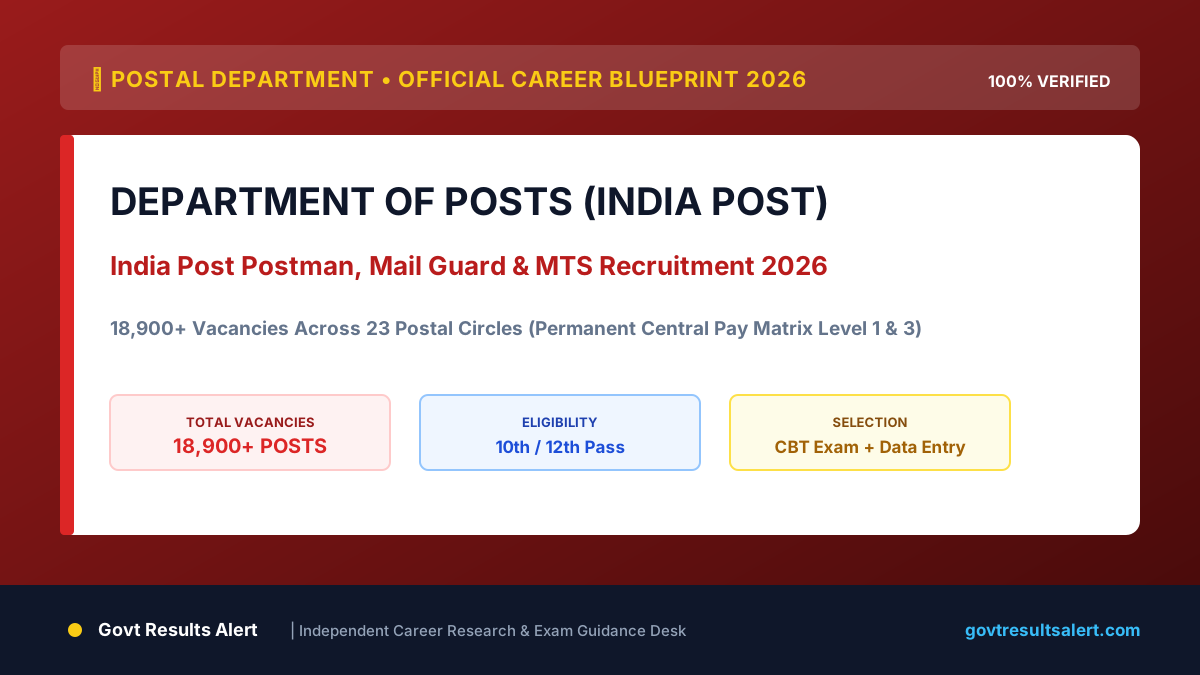
The Department of Posts (India Post), operating under the Ministry of Communications, Government of India, has unveiled the massive direct recruitment notification for 18,900+ vacancies in the departmental cadres of Postman, Mail Guard, and Multi-Tasking Staff (MTS) across all 23 Postal Circles nationwide. Unlike temporary or contractual branch arrangements, these positions represent regular Central Civil Service Group ‘C’ Non-Gazetted appointments with 7th Central Pay Commission (CPC) pay matrix privileges, pensionary entitlements, and steady departmental promotion avenues.
This comprehensive guide details the state-wise circle allocation, educational qualifications, local language mandates, Computer Based Examination framework, and online application guidelines.
India Post Recruitment 2026: Executive Highlights
| Parameter | Official Notification Specifications |
|---|---|
| Department | Department of Posts (India Post, Ministry of Communications) |
| Cadre Posts | Postman, Mail Guard & Multi-Tasking Staff (MTS) |
| Total Openings | 18,900+ Regular Departmental Vacancies |
| Pay Scales | Postman & Mail Guard: Pay Level-3 (₹21,700 – ₹69,100) | MTS: Pay Level-1 (₹18,000 – ₹56,900) |
| Minimum Qualification | Postman/Mail Guard: 12th Pass + Two-Wheeler License | MTS: 10th Pass (Matriculation) |
| Local Language Rule | Must have studied local language of the respective circle up to 10th Standard |
| Selection Flow | Paper-I (Basic Postal Aptitude CBT) ➔ Paper-II (Local Language) ➔ Paper-III (Data Entry DEST) |
| Official Portal | www.indiapost.gov.in |
Circle-Wise Approximate Vacancy Allocations (Major Postal Circles)
| Postal Circle | Designated Local Language | Approximate Posts |
|---|---|---|
| Uttar Pradesh Circle | Hindi | 2,450 |
| Maharashtra & Goa Circle | Marathi / Konkani | 2,180 |
| West Bengal & Sikkim Circle | Bengali / Nepali | 1,620 |
| Tamil Nadu Circle | Tamil | 1,540 |
| Bihar Circle | Hindi | 1,410 |
| Rajasthan Circle | Hindi | 1,120 |
| Madhya Pradesh Circle | Hindi | 1,080 |
| Karnataka Circle | Kannada | 990 |
| Other Postal Circles | Respective Circle Languages | 6,510 |
| All-India Total Openings | 23 Circles | 18,900+ |
Eligibility Conditions & Essential Criteria
- Academic Qualification:
- For Postman and Mail Guard: 12th Standard (10+2) pass from a recognized board of school education. Candidates must have basic computer operation certificate and possess a valid Driving License to drive two-wheeler or light motor vehicle (LMV).
- For Multi-Tasking Staff (MTS): 10th Standard (Matriculation) pass from a recognized educational board.
- Local Language Requirement: The candidate must have studied the designated local language of the concerned Postal Circle at least up to 10th standard as a compulsory or elective subject.
- Age Limit: 18 to 27 years for Postman/Mail Guard, and 18 to 25 years for MTS. Standard statutory relaxations apply: 5 years for SC/ST, 3 years for OBC(NCL), and 10 years for PwBD applicants.
Examination Scheme & Evaluation Architecture
The examination consists of three specialized papers conducted in single or multi-session test formats:
Paper-I: Basic Postal Aptitude & General Knowledge (Competitive – 100 Marks / 60 Mins)
| Part / Subject | Questions | Marks |
|---|---|---|
| Part A: General Awareness & Current Affairs | 25 | 25 Marks |
| Part B: Basic Arithmetic & Mathematical Calculations | 25 | 25 Marks |
| Part C: Reasoning & Analytical Ability | 25 | 25 Marks |
| Part D: Postal Knowledge (Post Office Guide Part-1 & Products) | 25 | 25 Marks |
| Total Merit Component | 100 Questions | 100 Marks |
Paper-II: Knowledge of Local Language (Qualifying – 50 Marks / 45 Mins)
Translation of 15 words from English to Local Language and 15 words from Local Language to English, accompanied by a letter writing and short essay of 40-50 words in the local language.
Paper-III: Data Entry Skill Test (DEST – Qualifying / 15 Mins)
For Postman and Mail Guard cadres only: Data entry test of 600 key depressions (± 5%) on computer within 15 minutes.
How to Apply Online for India Post Postman & Mail Guard
- Visit the official Department of Posts online portal at indiapost.gov.in.
- Navigate to Recruitment ➔ Direct Recruitment of Postman, Mail Guard & MTS 2026.
- Complete Part-I Registration with personal credentials, Aadhaar number, and circle choice.
- Enter 10th and 12th standard educational marks, board roll numbers, and driving license details.
- Upload clear passport photograph, signature, and community reservation certificates.
- Pay the examination fee of ₹100 (Exempted for Female, SC, ST, and PwBD candidates).
- Submit the application form and print the confirmation page for document verification reference.
Frequently Asked Questions (FAQs)
Q1: Is this recruitment for Gramin Dak Sevaks (GDS) or regular departmental staff?
This recruitment is for permanent departmental Central Civil Services Group ‘C’ posts (Postman, Mail Guard, and MTS) under the 7th CPC Pay Matrix Level 1 and Level 3, distinct from the contractual GDS engagement.
Q2: Is a two-wheeler driving license mandatory at the time of application for Postman?
Candidates applying for Postman positions must have a valid two-wheeler or Light Motor Vehicle (LMV) driving license. PwBD candidates are exempted from this driving license requirement.
Q3: Can a candidate apply for multiple postal circles?
No. Candidates must choose only ONE postal circle based on their local language proficiency and circle preferences.
Q4: How is the final merit list compiled?
Final merit is formulated strictly based on marks scored in Paper-I, subject to qualifying Paper-II (Local Language) and Paper-III (DEST skill test).

Ram Avtar is the Founder and Lead Career Analyst at Govt Results Alert. With over 6 years of experience analyzing Government Recruitment Notifications, SSC, Banking, and Railway examination patterns, he leads our fact-checking team to deliver authentic, timely, and verified job alerts directly from official government gazettes.