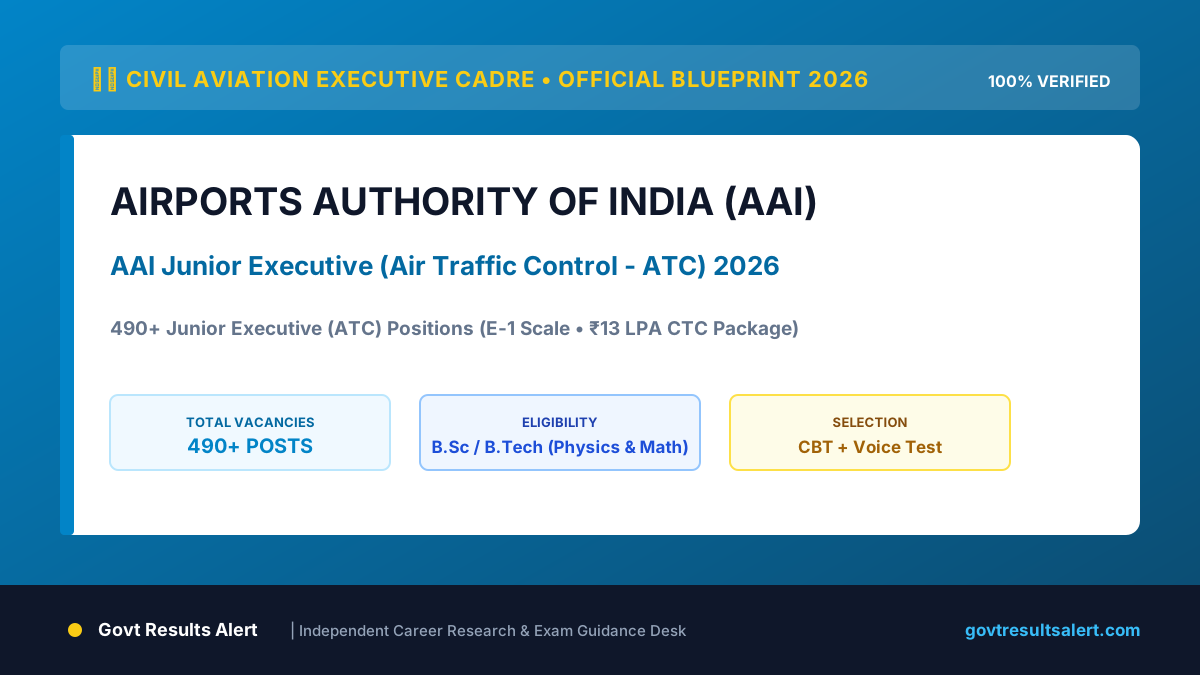
The Airports Authority of India (AAI), a premier Miniratna Category-1 Public Sector Enterprise under the Ministry of Civil Aviation, Government of India, has released the direct recruitment notification for 490+ Junior Executive (Air Traffic Control – ATC) positions. Entrusted with controlling civil air traffic, radar vectoring, airspace safety, and navigation management across all international, domestic, and customs airports in India, AAI Air Traffic Controllers enjoy an executive Pay Scale (E-1) with a lucrative Cost to Company (CTC) package of approximately ₹13.0 Lakhs Per Annum.
This comprehensive guide details the educational degree qualifications, age criteria, the 120-question Computer Based Test (CBT) scheme, voice test and psychoactive substance testing benchmarks, and step-by-step application instructions.
AAI Junior Executive (ATC) 2026: Executive Overview
| Recruitment Detail | Official Specifications |
|---|---|
| Recruiting Body | Airports Authority of India (AAI, Ministry of Civil Aviation) |
| Post Designation | Junior Executive (Air Traffic Control – ATC) |
| Total Openings | 490+ Executive Officers (All Major Airports in India) |
| Pay Scale & Package | Grade E-1 (Basic ₹40,000 – ₹1,40,000 + IDA, HRA, Perks @ 35% • CTC ~₹13.0 LPA) |
| Essential Qualification | Full-time 3-Year B.Sc with Physics & Mathematics OR Full-time B.E. / B.Tech in any discipline |
| Language Proficiency | Must have passed English as a subject at 10+2 level with clear voice & speech articulation |
| Selection Flow | Computer Based Test (120 Questions – No Negative Marking) ➔ Voice Test & Psychological Assessment ➔ Medical |
| Official Portal | www.aai.aero/careers |
Eligibility Conditions: Educational Criteria & Age Relaxations
- Academic Qualifications:
- Full-time regular 3-year Bachelor’s Degree in Science (B.Sc) with Physics and Mathematics from a recognized university with minimum 60% marks.
- OR Full-time regular Bachelor’s Degree in Engineering / Technology (B.E. / B.Tech) in any discipline with minimum 60% marks (Physics and Mathematics must be subjects in any one of the semester curricula).
- The candidate must possess spoken and written proficiency in English of the standard of 10+2 (passed English as one of the subjects in 10th or 12th standard).
- Age Limit: Maximum age 27 years as on the crucial cutoff date.
- OBC (Non-Creamy Layer): 3 years relaxation (up to 30 years).
- SC / ST candidates: 5 years relaxation (up to 32 years).
- PwBD: 10 years relaxation.
- AAI departmental employees: Relaxable by 5 years.
Online Examination Blueprint (120 Marks / 120 Mins — NO Negative Marking)
The Computer Based Test (CBT) consists of 120 objective questions with zero negative marking penalty:
| Part / Subject Domain | Questions | Marks | Duration |
|---|---|---|---|
| Part A (Non-Technical Domain): • English Language (20 Qs) • General Intelligence & Reasoning (15 Qs) • General Aptitude / Numerical Ability (15 Qs) • General Knowledge / Awareness (10 Qs) |
60 | 60 Marks | 120 Minutes (2 Hours Composite) |
| Part B (Technical Core Discipline): • 10+2 Standard Physics (Mechanics, Waves, Optics, Modern Physics) (30 Qs) • 10+2 Standard Mathematics (Calculus, Coordinate Geometry, Matrices, Probability) (30 Qs) |
60 | 60 Marks | |
| Total Online CBT | 120 Questions | 120 Marks | No Negative Marking |
Detailed Part B Syllabus: Physics & Mathematics Modules
Part B carries 50% of the total CBT weightage (60 questions). Questions are calibrated to rigorous CBSE Class 11th and 12th curriculum standards:
- Core Physics Modules (30 Questions): Mechanics (Laws of Motion, Work, Energy and Power, Rotational Dynamics), Thermal Physics and Thermodynamics, Electrostatics & Current Electricity, Magnetic Effects of Current & Magnetism, Electromagnetic Induction & Alternating Currents, Wave Optics & Ray Optics, Dual Nature of Radiation & Matter, Atoms & Nuclei, and Semiconductor Electronics.
- Core Mathematics Modules (30 Questions): Differential & Integral Calculus (Limits, Continuity, Differentiation, Definite Integrals, Differential Equations), Coordinate Geometry & 3D Geometry, Matrices & Determinants, Vector Algebra, Probability & Statistics, Permutations & Combinations, and Linear Programming.
Emoluments, Monthly Pay Scale & Executive Perks Structure
| Salary Component | Official Entitlement & Calculation |
|---|---|
| Pay Scale (Grade E-1) | ₹40,000 – 3% – ₹1,40,000/- (Executive Scale) |
| Starting Basic Pay | ₹40,000/- per month |
| Industrial Dearness Allowance (IDA) | Applicable Central PSU IDA rates (currently ~43.8% of Basic) |
| House Rent Allowance (HRA) | 27% (X Class metro airports), 18% (Y Class), or 9% (Z Class) |
| Perks & Cafeteria Allowances | 35% of Basic Pay towards conveyance, medical, and education |
| Gross Monthly Remuneration | Approx. ₹95,000 to ₹1,05,000/- per month (Metro postings) |
| Cost to Company (CTC) | Approximately ₹13.0 Lakhs Per Annum (includes CPF, Gratuity, Medical Insurance) |
Voice Test, Psychological Assessment & Medical Clearance
Candidates scoring above the CBT cutoff are shortlisted for the subsequent rounds at designated regional civil aviation centres:
- Voice Test: Assesses clarity of speech, diction, accent intelligibility, absence of stammering, and rapid comprehension of air traffic terminology in English.
- Psychological Assessment Test: Evaluates mental composure under high-stress air traffic simulations and situational awareness.
- Medical Fitness & Substance Testing: Class-3 Civil Aviation Medical Examination and screening for psychoactive substances (narcotics/drugs) in accordance with Directorate General of Civil Aviation (DGCA) regulations.
How to Apply Online for AAI ATC Junior Executive
- Visit the official portal at aai.aero and open the Careers section.
- Click on Direct Recruitment of Junior Executive (Air Traffic Control) 2026.
- Complete basic registration with mobile number, email, and identity documents.
- Enter graduation percentages, semester physics & mathematics details, and English language confirmation.
- Upload clear passport photograph and signature conforming to AAI technical pixel parameters.
- Pay the application fee of ₹1,000 (Exempted for SC, ST, Female, and PwBD candidates, as well as AAI apprentices).
- Submit the registration and download the printable application summary for documentation.
Frequently Asked Questions (FAQs)
Q1: Is there any negative marking in the AAI ATC online examination?
No. As per official AAI recruitment guidelines, there is no negative marking for incorrect answers in the Computer Based Test.
Q2: Can engineering graduates from any branch apply for AAI ATC?
Yes, candidates possessing a B.E. / B.Tech degree in any engineering discipline (Mechanical, Civil, CS, Electrical, etc.) are eligible, provided Physics and Mathematics were studied in any of the semesters.
Q3: Is a GATE score required for AAI Junior Executive (Air Traffic Control)?
No. Recruitment to the ATC cadre is conducted via an independent direct Computer Based Test conducted by AAI; a GATE score is not required.
Q4: Where does training take place after selection?
Selected Junior Executives undergo approximately 6 to 9 months of comprehensive institutional air traffic controller training at the Civil Aviation Training College (CATC), Prayagraj.
Q5: What is the service agreement bond for AAI Junior Executive?
Candidates selected for the post of Junior Executive (ATC) are required to execute a Service Bond of ₹3,00,000/- (Rupees Three Lakhs only) to serve the Airports Authority of India for a mandatory minimum period of 3 years after completion of training.

Ram Avtar is the Founder and Lead Career Analyst at Govt Results Alert. With over 6 years of experience analyzing Government Recruitment Notifications, SSC, Banking, and Railway examination patterns, he leads our fact-checking team to deliver authentic, timely, and verified job alerts directly from official government gazettes.