
⚠️ Important Notice: The online application registration process for RBI Grade B Officer Recruitment 2026 (Advt No. RBISB/DA/01/2026-27) was open from April 29, 2026 to May 20, 2026 and is currently closed. The Phase I Online Examination was conducted on June 13–14, 2026, and the Phase II Online Examination took place on July 25–26, 2026. This page serves as a permanent reference guide detailing stream-wise eligibility criteria, Phase 1 & Phase 2 paper patterns, gross monthly salary structures, and selection procedures for candidates tracking Reserve Bank of India recruitment cycles.
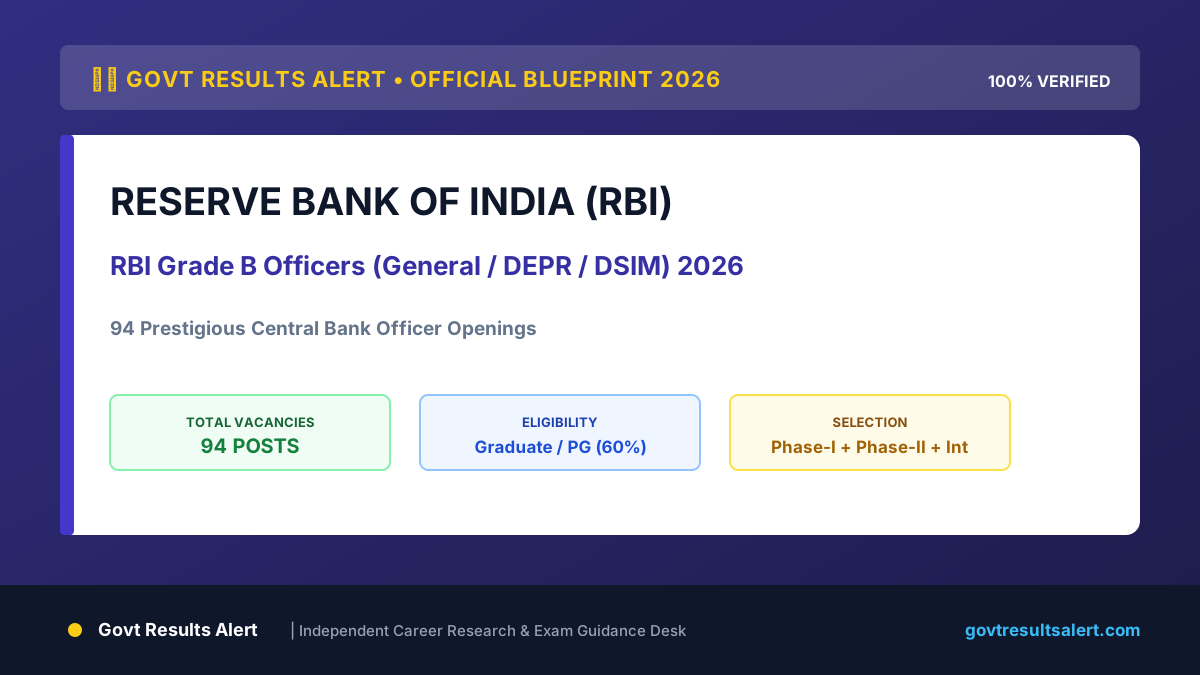
The Reserve Bank of India Services Board (RBISB) officially issued Advertisement Notification No. RBISB/DA/01/2026-27 to recruit 60 Officers in Grade ‘B’ (Direct Recruit – DR) vacancies across three specialized streams: General Cadre, Department of Economic and Policy Research (DEPR), and Department of Statistics and Information Management (DSIM).
As India’s central banking authority, RBI offers direct entry into executive management with a 3-stage selection process comprising a **Phase I Screening Test, Phase II Main Written Examination (Objective + Descriptive), and Personal Interview**.
📌 RBI Grade B Recruitment 2026: Key Overview
| Parameter | Details |
|---|---|
| Recruiting Organization | Reserve Bank of India (RBI) / Reserve Bank of India Services Board |
| Advertisement Number | RBISB/DA/01/2026-27 |
| Post Cadres | Officers in Grade ‘B’ (DR) – General, DEPR, and DSIM Streams |
| Total Vacancies | 60 Posts (Pan-India) |
| Educational Qualification | Graduation (60% Marks) / Post-Graduation (55% Marks) in relevant streams |
| Age Limit (Cutoff: 01 April 2026) | 21 to 30 Years (Up to 32 Years for M.Phil./Ph.D. holders; Category relaxation applies) |
| Starting Basic Pay | ₹55,200/- per month (Scale of ₹55,200 – ₹99,750) |
| Gross Starting Emoluments | ₹1,16,000 to ₹1,40,000+ per month (approx. including all allowances) |
| Selection Mode | Phase I (200 Marks) ➔ Phase II (300 Marks) ➔ Interview (75 Marks) |
| Application Fee | ₹850 + 18% GST (General/OBC/EWS) | ₹100 + 18% GST (SC/ST/PwBD) | Nil (Staff) |
| Official Portal | opportunities.rbi.org.in / ibpsreg.ibps.in |
📅 Official Recruitment Schedule & Timelines
| Recruitment Phase | Official Schedule |
|---|---|
| Official Newspaper Advertisement Release | April 28, 2026 |
| Detailed Notification PDF Release Date | April 29, 2026 |
| Online Registration & Fee Payment Start Date | April 29, 2026 |
| Closing Date for Online Application Registration | May 20, 2026 (06:00 PM) |
| Application Form Edit Window | May 25 to May 26, 2026 |
| Phase I Online Exam (General Stream) | June 13, 2026 |
| Phase I Online Exam (DEPR / DSIM Streams) | June 14, 2026 |
| Phase II Online Written Exam (General Stream) | July 25, 2026 |
| Phase II Online Written Exam (DEPR / DSIM Streams) | July 26, 2026 |
🏢 Stream-Wise & Category-Wise Vacancy Breakdown
The total 60 Grade B Officer vacancies are allocated across categories and specialized streams as follows:
| Stream Cadre | UR / GEN | EWS | OBC | SC | ST | Total Posts |
|---|---|---|---|---|---|---|
| Grade ‘B’ (DR) – General Cadre | 16 | 04 | 09 | 07 | 04 | 40 |
| Grade ‘B’ (DR) – DEPR Cadre | 04 | 01 | 01 | 03 | 01 | 10 |
| Grade ‘B’ (DR) – DSIM Cadre | 04 | 01 | 04 | 01 | 00 | 10 |
| Total Vacancies | 24 | 06 | 14 | 11 | 05 | 60 Posts |
Horizontal reservation applies for Persons with Benchmark Disabilities (PwBD) across relevant categories per Government of India guidelines.
🎓 Stream-Wise Educational Eligibility & Attempts Criteria
Candidates must strictly fulfill academic requirements as of the specified cutoff date:
1. Officers in Grade ‘B’ (DR) – General Stream
- Graduation Level: Bachelor’s Degree in any discipline with a minimum of 60% aggregate marks (50% for SC, ST, and PwBD candidates) from a recognized University. OR
- Post-Graduation Level: Master’s Degree / Post-Graduate Diploma in any discipline with a minimum of 55% aggregate marks (Pass marks for SC, ST, and PwBD candidates).
- Maximum Number of Attempts: Candidates belonging to the General/Unreserved category who have already appeared 6 times in the Phase I examination for this post in the past are ineligible. No attempt limit applies to SC, ST, OBC, EWS, and PwBD candidates.
2. Officers in Grade ‘B’ (DR) – DEPR Stream
- Must possess a Master’s Degree in Economics / Econometrics / Quantitative Economics / Mathematical Economics / Integrated Economics / Finance with at least 55% aggregate marks (50% for SC/ST/PwBD).
3. Officers in Grade ‘B’ (DR) – DSIM Stream
- Must possess a Master’s Degree in Statistics / Mathematical Statistics / Mathematical Economics / Econometrics / Data Science / Artificial Intelligence / Bio-Statistics with minimum 55% aggregate marks.
🔞 Age Limit Criteria & Upper Age Relaxations (As of 01 April 2026)
- Minimum Age Limit: 21 Years (Born not earlier than April 02, 1996 and not later than April 01, 2005)
- Maximum Age Limit (General / Unreserved): 30 Years (Extended to 32 years for candidates possessing M.Phil. or Ph.D. degrees)
Category-Wise Upper Age Relaxations
| Candidate Category | Upper Age Relaxation | Effective Maximum Age |
|---|---|---|
| General / Unreserved / EWS | No Relaxation | 30 Years |
| OBC (Non-Creamy Layer) | 3 Years | 33 Years |
| Scheduled Caste (SC) / Scheduled Tribe (ST) | 5 Years | 35 Years |
| Persons with Benchmark Disabilities (PwBD) | 10 to 15 Years (Category-dependent) | 40 to 45 Years |
| Ex-Servicemen | 5 Years | 35 Years |
💰 Salary Structure, Allowances & Perquisites
- Pay Scale Architecture: Selected Officers enter at a starting basic pay of ₹55,200/- per month in the scale of ₹55,200 – 2850(9) – 80850 – EB – 2850(2) – 86550 – 3300(4) – 99750 (16 years).
- Gross Monthly Salary: Including Dearness Allowance (DA), Local Allowance, House Rent Allowance (HRA), Family Allowance, and Grade Allowance, initial gross monthly compensation is approximately ₹1,16,000 to ₹1,40,000+ per month.
- Perquisites & Facilities: Bank’s official accommodation (subject to availability), reimbursement of expenses for maintenance of vehicle for official purpose, newspaper, telephone charges, book grant, allowance for furnishing of residence, free medical facility for self and dependents, Interest-Free Festival Advance, and concessional loan facilities for housing/car.
⚙️ Selection Process & Detailed Examination Pattern
The recruitment follows a 3-tier competitive evaluation mechanism:
Phase I: Objective Screening Test (General Stream – 200 Marks)
An objective online examination comprising 200 questions (Duration: 120 Minutes) with sectional timing and 1/4th negative marking penalty:
| Subject Section | Questions / Marks |
|---|---|
| General Awareness (Current Affairs, Banking & RBI Focus) | 80 Questions / 80 Marks |
| Reasoning Ability | 60 Questions / 60 Marks |
| Quantitative Aptitude | 30 Questions / 30 Marks |
| English Language | 30 Questions / 30 Marks |
| Total | 200 Questions / 200 Marks |
Note: Phase I marks serve strictly as a shortlisting filter for Phase II and are not counted towards final selection merit rankings.
Phase II: Main Written Examination (General Stream – 300 Marks)
Consists of three compulsory papers combining objective and computer-based descriptive formats:
| Paper Code | Subject Area | Format | Marks / Duration |
|---|---|---|---|
| Paper I | Economic and Social Issues (ESI) | 50% Objective + 50% Descriptive (Keyboard Typing) | 100 Marks / 90 Mins |
| Paper II | English (Writing Skills) | Descriptive (Essay, Precis Writing, Comprehension) | 100 Marks / 90 Mins |
| Paper III | Finance and Management (FM) | 50% Objective + 50% Descriptive (Keyboard Typing) | 100 Marks / 90 Mins |
| Total | 3 Compulsory Written Papers | Combined Objective & Descriptive | 300 Marks |
Phase III: Personal Interview (75 Marks)
Candidates scoring above the merit cutoffs in Phase II appear for a personal interview carrying 75 marks. Final selection merit lists are prepared by combining Phase II written scores (300 marks) and Interview scores (75 marks) out of a total of 375 marks.
💳 Application Fee Structure
| Candidate Category | Application Fee / Intimation Charges |
|---|---|
| General / OBC / EWS Candidates | ₹850/- + 18% GST |
| SC / ST / PwBD Candidates | ₹100/- + 18% GST |
| Regular RBI Staff Candidates | ₹0/- (Exempted) |
📄 Mandatory Documents Checklist
Originals and self-attested copies required during document verification rounds for shortlisted candidates:
- Class 10th / SSLC Marksheet & Passing Certificate (Proof of Date of Birth).
- Class 12th / Intermediate Marksheet and Certificate.
- Graduation / Post-Graduation Degree Marksheets (All Semesters/Years) and Final Degree Certificate.
- OBC Non-Creamy Layer Certificate issued on or after April 01, 2026 (based on FY 2023-24, 2024-25, 2025-26 income).
- Caste Certificate (SC/ST) / EWS Income & Asset Certificate in prescribed Government of India formats.
- Valid Photo Identity Proof (Aadhaar Card, PAN Card, or Passport).
- Printed Copy of Online Application Confirmation Form and Fee Payment Receipt.
📝 Step-by-Step Guide: How Online Registration Worked
- Visited the official RBI careers portal at opportunities.rbi.org.in under Current Vacancies ➔ Vacancies.
- Accessed the notification link: Recruitment of Officers in Grade ‘B’ (DR) (General/DEPR/DSIM) – Panel Year 2026.
- Clicked on Apply Online to redirect to the IBPS application portal (
ibpsreg.ibps.in/rbisbmar26/). - Completed New Registration by entering legal name, active mobile number, and email ID to obtain Registration Credentials.
- Filled educational aggregate percentages, attempt history, and regional exam center preferences carefully.
- Uploaded scanned passport photograph (20–50 KB), signature in black ink (10–20 KB), left thumb impression, and handwritten declaration (50–100 KB).
- Paid application fee online (₹850 + GST for General/OBC; ₹100 + GST for SC/ST/PwBD) via Net Banking, Debit/Credit Card, or UPI.
- Submitted the form and downloaded the generated summary PDF for personal records.
⚠️ Frequently Asked Questions (FAQs)
1. How many attempts are allowed for General category candidates in RBI Grade B?
Candidates belonging to the General/Unreserved category who have already appeared 6 times in the Phase I preliminary examination for the Grade ‘B’ (DR) General post in the past are ineligible to apply. There is no attempt limit for SC, ST, OBC, EWS, and PwBD candidates.
2. Is there negative marking in the RBI Grade B Phase I preliminary exam?
Yes. A negative marking penalty of 1/4th (0.25) of the marks assigned to that question applies for every wrong answer in the Phase I objective test.
3. What is the starting gross monthly salary for an RBI Grade B Officer in 2026?
With a starting basic pay of ₹55,200 per month plus DA, HRA, and local allowances, initial gross monthly earnings range between ₹1,16,000 to ₹1,40,000+ per month depending on posting location.
4. Are final year students eligible to apply for RBI Grade B 2026?
No. Candidates must possess the required educational degree certificates with final marks declared on or before the application cutoff date (May 20, 2026).
Disclaimer: Govt Result Alert is an independent educational news portal providing updates on public sector banking and regulatory recruitments. We are not officially affiliated with the Reserve Bank of India (RBI) or the Reserve Bank of India Services Board. Aspirants are advised to cross-verify all official details directly at opportunities.rbi.org.in or rbi.org.in.
📊 Expert Cutoff Analysis & Preparation Strategy for RBI Grade B Officer
Based on our editorial analysis of previous recruitment cycles and increasing competition trends, candidates must aim for safe target scores rather than merely clearing the minimum qualifying benchmark:
- Expected Safe Target: General/UR candidates should target 78%–84% marks in the written examination, while OBC/EWS aspirants should aim for 74%–80%.
- Focus Areas: Prioritize high-scoring sections such as General Intelligence & Reasoning and Quantitative Aptitude. Daily revision of static General Awareness and current affairs from the past 6 months is essential.
- Time Management: Practice with full-length sectional and mock tests strictly in timed exam conditions to improve accuracy and eliminate negative marking errors.

Ram Avtar is the Founder and Lead Career Analyst at Govt Results Alert. With over 6 years of experience analyzing Government Recruitment Notifications, SSC, Banking, and Railway examination patterns, he leads our fact-checking team to deliver authentic, timely, and verified job alerts directly from official government gazettes.