
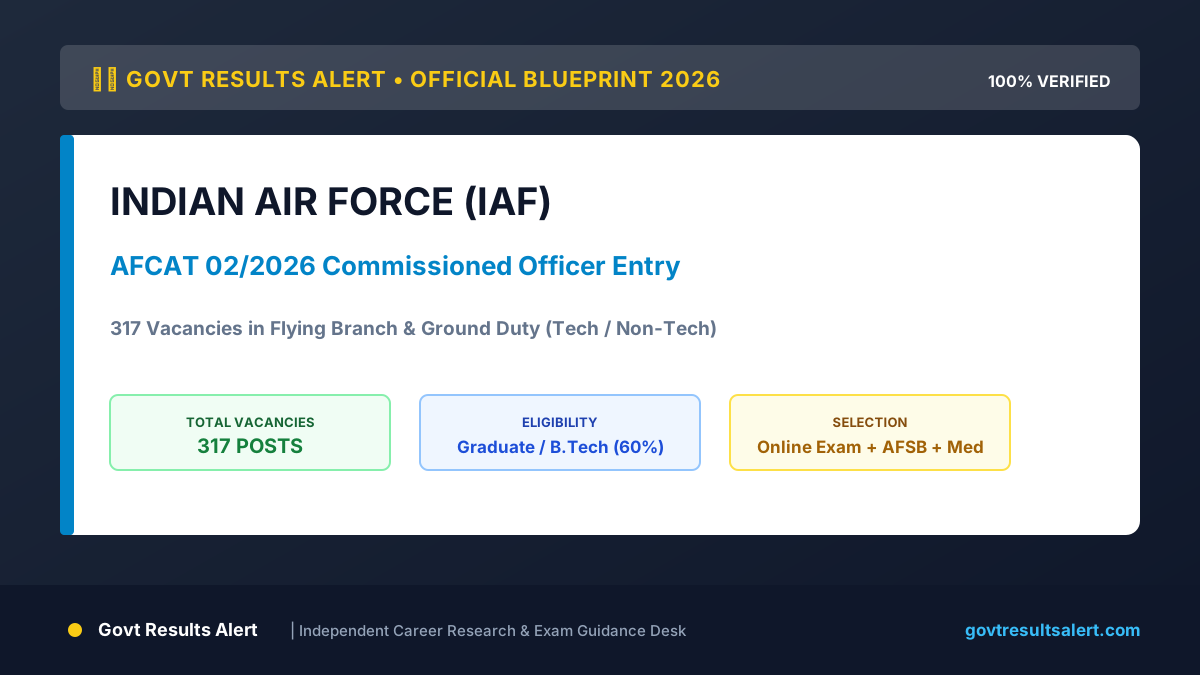
Essential Details: 379 Posts | Flying + Technical + Non-Technical | Apply: May 20 – June 19, 2026 | Website: afcat.cdac.in
Every year, roughly 3 to 4 lakh candidates register for AFCAT. Around 30,000 clear the written exam. Approximately 6,000 get called for SSB. About 1,200 clear SSB. Medical eliminates another 150 to 200. Final selections land somewhere around 900 to 1,000 officers across all cycles.
That progression — from 3,50,000 applicants to roughly 1,000 officers — tells you something important about what AFCAT actually is. It is not an exam you clear and then receive a job offer. It is the first gate in a four-gate process where each gate eliminates a significant majority of the people who entered.
Understanding this upfront changes how you approach the next four months.
The Indian Air Force has officially opened applications for AFCAT 2026 — 379 vacancies across the Flying Branch, Ground Duty Technical, and Ground Duty Non-Technical streams. Applications run from May 20 to June 19, 2026. If you are serious about an Air Force career and your eligibility genuinely checks out, this guide gives you the complete picture: what each stage actually tests, what the salary and career trajectory look like, how to apply correctly, and what eliminates candidates at each filter.
Three Branches, Three Completely Different Careers
The first decision you make on the AFCAT application form — which branch to apply for — is also the most consequential. These are not variations of the same job. They are fundamentally different careers that happen to share the same initial written examination.
Flying Branch — The Most Competitive Path
This is the branch that most people picture when they think of joining the Air Force. Pilots flying fighter aircraft, transport planes, and helicopters. The prestige is real. So is the difficulty of getting there.
The qualification requirement is a graduation degree or BE/BTech with minimum 60% marks, combined with Physics and Mathematics at the 12th level with 50% minimum. The age window is narrow — 20 to 24 years, extendable to 25 only if you hold a valid Commercial Pilot License.
But the real filter for Flying Branch is not academic. It is physical. Specifically, vision.
One eye must be 6/6. The other must be at minimum 6/9, correctable to 6/6. No color blindness. No night blindness. These standards are non-negotiable and checked rigorously during the medical examination, which is the final stage before selection.
Before you apply for Flying Branch, get your eyes tested at an eye clinic — not an optician, an actual ophthalmologist. If your uncorrected vision is worse than these standards, no amount of preparation changes that outcome. Apply for a ground duty branch where the vision standards are less stringent.
Ground Duty Technical — Engineering Applied to Aviation
Two sub-streams here. Aeronautical Engineering Electronics requires a BE/BTech in Electronics, Telecommunication, or Electrical Engineering with 60% minimum. Aeronautical Engineering Mechanical requires a BE/BTech in Mechanical, Aerospace, or Industrial Production Engineering with 60% minimum.
Ground Duty Technical officers handle aircraft maintenance at the engineering level, oversee technical operations, and manage the engineering infrastructure that keeps flying aircraft airworthy. The age limit extends to 26 years — two years more than Flying Branch — and vision standards, while still important, are less restrictive.
For engineering graduates whose passion for aviation runs through the technical side rather than the cockpit, this branch offers a career that directly uses their degree while providing all the benefits and structure of an Air Force commission.
Ground Duty Non-Technical — Five Sub-Streams
Administration and Logistics: Graduation in any discipline with 60% minimum, or postgraduate degree with 50% minimum. Covers organizational management, logistics operations, and administrative functions across Air Force stations.
Accounts: BCom with 60%, or MCom/CA/ICWA with 50%. Financial management and accounts functions.
Education: Postgraduate degree in English, History, Geography, Political Science, Economics, Psychology, Philosophy, Sociology, Statistics, International Relations, or Public Administration with 50%, or B.Ed/M.Ed. Air Force educational institutions and training wing roles.
Meteorology: Postgraduate degree in Physics, Mathematics, Statistics, Geophysics, Oceanography, or Meteorology with 50%. Weather forecasting and meteorological services that directly support flight operations.
The Non-Technical branches are often underappreciated by candidates who have their hearts set on Flying. But the career trajectory, compensation, service conditions, and prestige of a commissioned officer — regardless of branch — are comparable. A Squadron Leader in Accounts has the same rank, the same uniform, and most of the same benefits as a Squadron Leader pilot.
Age Limits and Application Fee
Age is calculated as on July 1, 2027 — not today’s date, not the application date. This is specific to AFCAT and catches candidates by surprise who calculate their age as of the application date.
Flying Branch: 20 to 24 years as on July 1, 2027. Ground Duty Technical and Non-Technical: 20 to 26 years as on July 1, 2027. SC/ST candidates get 5 years additional relaxation for Ground Duty branches.
| Category | Application Fee |
|---|---|
| General / OBC / EWS | ₹550 |
| SC / ST | Free |
| Female candidates | Free |
| NCC Special Entry | Free |
| GATE candidates | Free |
Payment through debit card, credit card, net banking, or UPI. Non-refundable.
Stage 1 — The Written Exam: What 300 Marks Looks Like
100 questions, 300 marks, 2 hours. Five sections of 20 questions each, worth 60 marks per section: General Awareness, English, Numerical Ability, Reasoning, and Military Aptitude.
The marking scheme demands a specific strategy. Each correct answer gives +3 marks. Each wrong answer costs -1 mark. This asymmetry means that attempting questions you are genuinely uncertain about can either gain you marks or lose you marks depending on your accuracy rate. The break-even point is getting 1 question right for every 3 you attempt on uncertain questions — below that break-even, you are better off leaving them blank.
In practice, this means two categories of questions: those you know confidently (attempt all of these), and those where you can eliminate at least two options (attempt these too, since the probability math works in your favor). Everything else — pure guesses where all four options seem equally plausible — leave blank.
General Awareness (60 marks) covers Indian history with emphasis on the freedom struggle, Indian polity including constitutional basics and parliamentary system, basic economics, Indian and world geography, science basics at the 10th level, current affairs from the last 6 to 8 months, and — specifically for AFCAT — defence news. Military exercises between India and other countries, new aircraft and missile inductions, IAF appointments and achievements, and defence policy developments are regularly tested. Candidates who read defence news regularly for months before the exam have a consistent advantage in this section.
English (60 marks) tests reading comprehension, cloze tests, synonyms and antonyms, idioms and phrases, error spotting, sentence completion, and para jumbles. The difficulty is moderate but the section requires consistent language exposure — not just grammar rules. Reading English editorials daily for two to three months improves performance here more than doing grammar exercises alone.
Numerical Ability (60 marks) covers percentage, average, ratio, time and work, speed and distance, simple and compound interest, profit and loss, and basic number systems. This is the section that separates candidates who are comfortable with calculation from those who struggle under time pressure. AFCAT numerical questions are generally at Class 10 to 12 difficulty level but require speed.
Reasoning and Military Aptitude (60 marks combined) covers series, venn diagrams, syllogism, blood relations, coding-decoding, direction sense, non-verbal reasoning including mirror and water images, pattern recognition, and spatial ability. Military aptitude specifically tests the kind of analytical thinking required for officer-level decision making.
Stage 2 — SSB: The Stage That Eliminates 80% of Written Exam Qualifiers
This is where AFCAT is fundamentally different from every other government recruitment discussed in this guide. The SSB is not an interview. It is a 5 to 7 day residential assessment conducted at one of the Air Force Selection Boards where trained psychologists, group testing officers, and interviewing officers collectively evaluate your personality, leadership potential, and officer-like qualities.
Day 1 — Screening: The OIR Test (Officer Intelligence Rating) is a verbal and non-verbal reasoning assessment. The PPDT (Picture Perception and Discussion Test) requires you to write a story based on a hazy image and then discuss it with a group of candidates. Day 1 cuts the group roughly in half — those who do not screen in go home that evening.
Days 2 to 4 — Psychological Tests and Group Tasks: The TAT (Thematic Apperception Test) presents 12 pictures and asks you to write a story for each — stories that reveal your personality, values, and thinking patterns to trained assessors. The WAT (Word Association Test) flashes 60 words rapidly and asks you to write the first sentence that comes to mind for each — responses that reveal your subconscious associations and mental patterns. The SRT (Situation Reaction Test) presents 60 real-world situations and asks how you would respond — again revealing your decision-making patterns. The Self-Description exercise asks you to write what you think of yourself, what your parents think, what your friends think, and what your teacher thinks — revealing self-awareness and consistency.
Group tasks include Group Discussion, Group Planning Exercise, physical obstacles requiring teamwork, and the Lecturette where you speak on a topic for three minutes in front of assessors and peers.
Day 5 — Personal Interview and Final Conference: A senior officer conducts a one-on-one interview covering your background, academic performance, current affairs knowledge, situational judgment, and reasons for wanting to join the Air Force. The conference that follows is where all assessors share their observations and collectively decide your outcome.
The honest truth about SSB preparation: candidates who genuinely have developed officer-like qualities through years of leadership, reading, sport, community involvement, and self-reflection consistently outperform candidates who have done 15-day crash courses specifically designed to “crack SSB.” You can prepare specific elements — improve your current affairs knowledge, practice speaking clearly, understand what assessors are looking for. But the foundation needs to exist.
Stage 3 and 4 — Documents and Medical
Document verification checks that every qualification you claimed is accurate. The most common rejection reason here is percentage mismatch — claiming 60% when the marksheet shows 59.8%. The Indian Air Force does not round percentages. Calculate your exact aggregate from your marksheets before entering the figure in your application.
Medical examination at an Air Force hospital is comprehensive. For Flying Branch the vision standards are particularly strict and color blindness is a disqualifying condition. Other common disqualifications across branches include asthma, flat feet, hearing deficiencies, and cardiovascular conditions. Get a thorough private medical checkup before investing months of preparation, particularly for Flying Branch candidates.
Salary — What a Flying Officer Actually Takes Home
All branches start at the rank of Flying Officer.
| Rank | Basic Pay Range |
|---|---|
| Flying Officer | ₹56,100 – ₹1,77,500 |
| Flight Lieutenant | ₹61,300 – ₹1,93,900 |
| Squadron Leader | ₹69,400 – ₹2,07,200 |
| Wing Commander | ₹1,21,200 – ₹2,12,400 |
| Group Captain | ₹1,30,600 – ₹2,15,900 |
The monthly in-hand for a new Flying Officer — after adding DA, HRA (or free government accommodation), transport allowance, and branch-specific allowances like Flying Allowance or Technical Allowance — works out to approximately ₹70,000 to ₹85,000 per month.
That figure, however, understates the real compensation. Officers live in Air Force stations with subsidized housing, subsidized canteen access, free medical treatment for themselves and their families, and Leave Travel Concession. When you account for expenses that civilians pay from their salary — rent, electricity, medical insurance — the effective financial advantage of an Air Force commission is significantly larger than the salary number alone suggests.
How to Apply — Complete Process
Go to afcat.cdac.in. Click on AFCAT 2026 Apply Online. New registration requires your name, mobile number, and email ID. OTP verification creates your account — note the registration number and password immediately.
Fill the application form covering personal details, educational qualifications with exact percentages, branch preference (you can indicate up to three preferences in order), and exam city preferences. Upload photograph — passport size, recent, professional (not a selfie, not cropped from a group photo). Upload signature — black pen on white paper.
Pay ₹550 if you are in a fee-paying category. Preview the complete form. Check branch selection, percentage figures, and date of birth with particular care — these are the fields most commonly entered incorrectly. Click Final Submit only after verifying everything.
Download and print the confirmation page. Keep two copies.
Important Dates
| Event | Date |
|---|---|
| Application Opens | May 20, 2026 |
| Last Date to Apply | June 19, 2026 |
| AFCAT Written Exam | To be announced |
| SSB Dates | Post written result |
Apply by June 12 to avoid last-day server issues.
Quick Reference
| Detail | Information |
|---|---|
| Organization | Indian Air Force |
| Exam | AFCAT 2026 |
| Total Vacancies | 379 |
| Branches | Flying, Ground Duty Technical, Ground Duty Non-Technical |
| Application Fee | ₹550 (Free for SC/ST/Women/NCC/GATE) |
| Starting Salary | ₹70,000–₹85,000/month in-hand |
| Age | 20–24 (Flying) / 20–26 (Ground Duty) |
| Last Date | June 19, 2026 |
Official Website: afcat.cdac.in
Disclaimer: Based on the official AFCAT 2026 notification. Vacancy numbers, selection ratios, and salary figures are approximate. Always verify from afcat.cdac.in before applying. This article is for informational purposes only.
📊 Expert Cutoff Analysis & Preparation Strategy for AFCAT 2026 — 379 Vacancies, Flying Officer Salary ₹85,000, Apply by June 19 | Complete Reality Check
Based on our editorial analysis of previous recruitment cycles and increasing competition trends, candidates must aim for safe target scores rather than merely clearing the minimum qualifying benchmark:
- Expected Safe Target: General/UR candidates should target 78%–84% marks in the written examination, while OBC/EWS aspirants should aim for 74%–80%.
- Focus Areas: Prioritize high-scoring sections such as General Intelligence & Reasoning and Quantitative Aptitude. Daily revision of static General Awareness and current affairs from the past 6 months is essential.
- Time Management: Practice with full-length sectional and mock tests strictly in timed exam conditions to improve accuracy and eliminate negative marking errors.

Ram Avtar is the Founder and Lead Career Analyst at Govt Results Alert. With over 6 years of experience analyzing Government Recruitment Notifications, SSC, Banking, and Railway examination patterns, he leads our fact-checking team to deliver authentic, timely, and verified job alerts directly from official government gazettes.