
⚠️ Important Notice: The online application registration process for BPSSC Bihar Police Havaldar Instructor Recruitment 2026 (Advt No. 02/2026) was open from May 01, 2026 to May 31, 2026 and is currently closed. The OMR-based written examination was conducted on July 12, 2026. This page serves as an educational reference guide detailing Class 12th eligibility parameters, uniform 18–40 age criteria, Physical Efficiency Test (PET) standards, and Level-4 pay matrix structures for Bihar Police Subordinate Services Commission vacancy cycles.
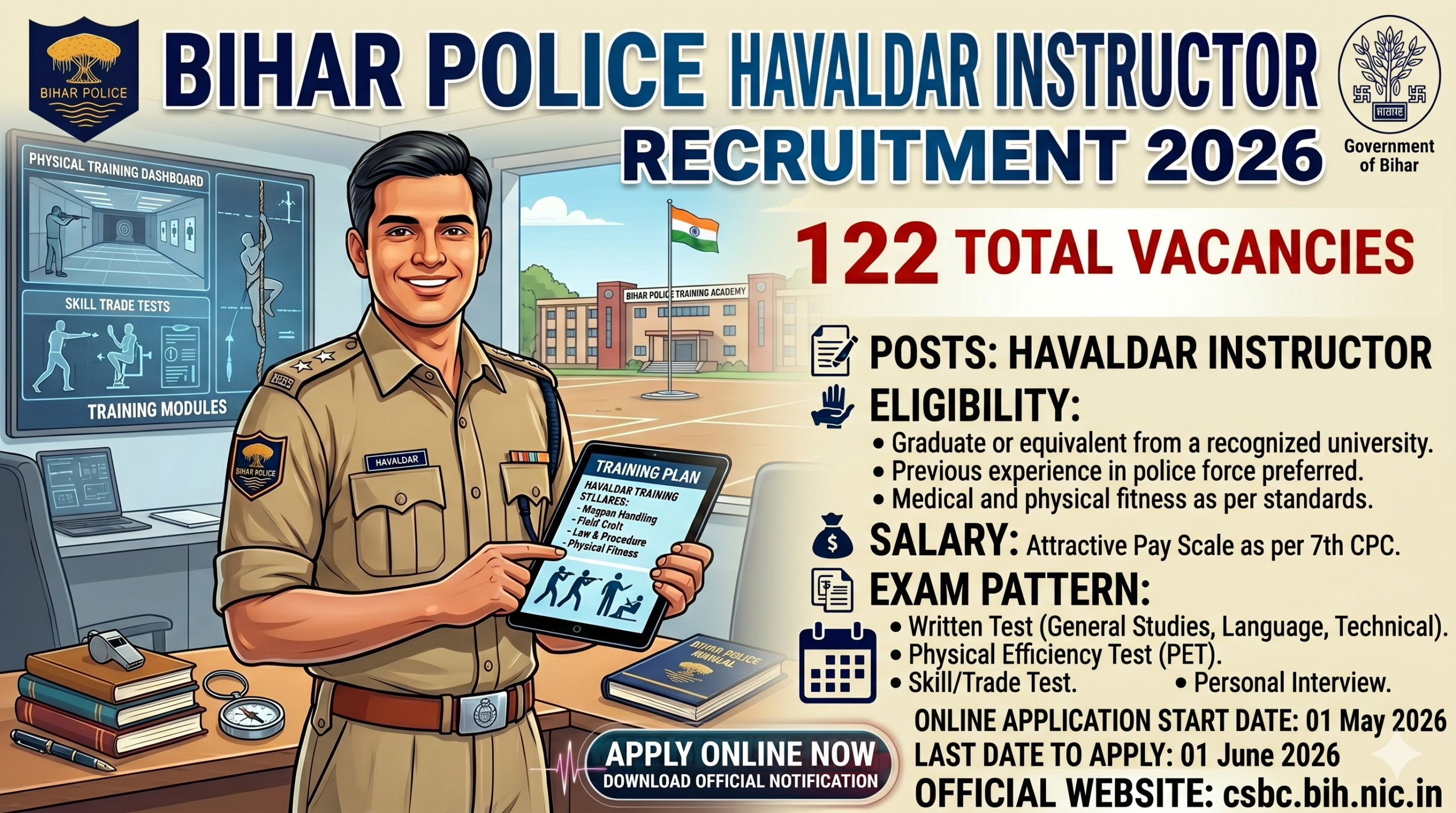
The Bihar Police Subordinate Services Commission (BPSSC) officially issued Advertisement Notification No. 02/2026 to recruit 122 Havaldar Instructor vacancies within the Bihar Police Training Cadre under the Home Department, Government of Bihar.
Selected personnel serve as technical drill and weapons instructors across Bihar police training academies and centers. Selection is governed through a multi-stage process comprising a 100-mark OMR Written Examination, a mandatory Physical Efficiency Test (PET / PST), Document Verification, and a Medical Examination.
📌 BPSSC Bihar Police Havaldar Instructor 2026: Key Overview
| Parameter | Details |
|---|---|
| Recruiting Commission | Bihar Police Subordinate Services Commission (BPSSC) |
| Advertisement Number | Advt. No. 02/2026 |
| Post Cadre | Havaldar Instructor (Bihar Police Training Cadre) |
| Total Vacancies | 122 Posts |
| Educational Qualification | Class 12th (Intermediate / 10+2) Pass from a Recognized Board |
| Age Limit (Cutoff: 01 January 2026) | 18 to 40 Years (Uniform upper age limit for all categories) |
| Pay Scale Matrix | Level 4 (₹25,500 – ₹81,100) + Bihar Govt Allowances |
| Starting In-Hand Salary | ₹34,000 to ₹40,000 per month (approx.) |
| Selection Mode | Written Exam (100 Marks) + PET / PST + DV & Medical Exam |
| Application Fee | ₹100 (Flat fee for all candidate categories) |
| Official Website | bpssc.bihar.gov.in |
📅 Official Recruitment Schedule & Timelines
| Recruitment Phase | Official Schedule |
|---|---|
| Official Notification Release Date | April 28, 2026 |
| Online Application Window Start Date | May 01, 2026 |
| Closing Date for Submission of Online Form | May 31, 2026 (23:59 hrs) |
| Last Date for Online Fee Payment | May 31, 2026 |
| OMR Written Examination Date | July 12, 2026 |
| Physical Efficiency Test (PET) Schedule | To Be Announced On BPSSC Portal |
🏢 Category-Wise Vacancy Distribution
The total 122 Havaldar Instructor vacancies are allocated across categories as per Bihar Government reservation rules:
| Category Name | Allocated Vacancies |
|---|---|
| Unreserved (UR / General) | 48 |
| Extremely Backward Class (EBC) | 22 |
| Scheduled Caste (SC) | 19 |
| Backward Class (BC) | 15 |
| Economically Weaker Section (EWS) | 12 |
| Backward Class Female (BC-F) | 04 |
| Scheduled Tribe (ST) | 02 |
| Total Vacancies | 122 Posts |
🎓 Detailed Educational & Proficiency Eligibility
- Academic Requirement: Must have passed Class 12th (Intermediate / 10+2) or equivalent from a recognized Board (BSEB, CBSE, ICSE, or State Boards) on or before the application cutoff date.
- Language Proficiency: Basic reading, writing, and speaking proficiency in both Hindi and English is required.
- Higher Qualifications: Graduates and Post-Graduates are eligible to apply but are evaluated on par with 12th pass criteria (12th marks serve as the primary parameter for tie-breaking in merit ranks).
🔞 Age Limit Criteria (As of 01 January 2026)
- Minimum Age Limit: 18 Years
- Maximum Age Limit: 40 Years (Uniform maximum ceiling applicable across General, EWS, BC, EBC, SC, ST, and Female categories per notification rules).
- Ex-Servicemen Relaxation: Service period + 3 Years (up to a maximum ceiling of 5 years relaxation).
📐 Physical Standard Test (PST) Benchmarks
Candidates must meet mandatory physical measurement criteria prior to PET qualification:
| Gender & Category | Minimum Height Standard | Chest Standard (Unexpanded / Expanded) |
|---|---|---|
| Male (General / BC / EBC) | 165 cm | 81 cm / 86 cm (Minimum 5 cm expansion) |
| Male (SC / ST) | 160 cm | 81 cm / 86 cm (Minimum 5 cm expansion) |
| Female (General / BC / EBC) | 155 cm | Not Applicable |
| Female (SC / ST) | 150 cm | Not Applicable |
🏃 Physical Efficiency Test (PET) Qualification Rules
The Physical Efficiency Test is strictly qualifying in nature (Pass/Fail):
| PET Event | Male Candidates Standard | Female Candidates Standard |
|---|---|---|
| Race (Running) | 1.6 km (1600 meters) within 6 Minutes | 1.0 km (1000 meters) within 6 Minutes |
| High Jump | Minimum 4 Feet (3 Attempts allowed) | Minimum 3 Feet (3 Attempts allowed) |
| Long Jump | Minimum 12 Feet (3 Attempts allowed) | Minimum 9 Feet (3 Attempts allowed) |
| Shot Put (Gola Fenk) | 16 Pound Ball to Minimum 16 Feet | 12 Pound Ball to Minimum 10 Feet |
💰 Salary Structure & Allowances (Pay Level 4)
- Pay Matrix Scale: Pay Level 4 under 7th CPC (₹25,500 – ₹81,100 per month).
- Estimated Starting Monthly Compensation: Basic Pay ₹25,500 plus Dearness Allowance (DA), House Rent Allowance (HRA), Uniform Allowance, Ration Money Allowance, and Medical Allowance. Starting gross in-hand salary ranges between ₹34,000 to ₹40,000 per month depending on posting location.
⚙️ Written Exam Pattern & Selection Stages
The written evaluation consists of a single OMR-based offline paper (Duration: 2 Hours):
| Subject Area | Question Allocation / Marks |
|---|---|
| Language (Hindi & English Grammar & Comprehension) | 25 Questions / 25 Marks |
| Mathematics (Class 10th Standard Arithmetic) | 25 Questions / 25 Marks |
| Social Science (History, Geography, Civics, Bihar GK) | 20 Questions / 20 Marks |
| General Science (Physics, Chemistry, Biology) | 20 Questions / 20 Marks |
| General Knowledge & Current Affairs | 10 Questions / 10 Marks |
| Total | 100 MCQs / 100 Marks |
Note: Minimum qualifying score in the written examination is 30% (30 Marks out of 100). Shortlisting for PET is done in a 1:5 ratio per vacancy based on written merit rankings.
💳 Application Fee Structure
| Candidate Category | Application Processing Fee |
|---|---|
| All Categories (General / BC / EBC / EWS / SC / ST / Female) | ₹100/- (Flat Processing Fee) |
📄 Mandatory Documents Checklist
Originals and self-attested copies required during Document Verification rounds:
- Class 10th (Matriculation) Marksheet & Certificate (Proof of Date of Birth).
- Class 12th (Intermediate / 10+2) Marksheet and Passing Certificate.
- Bihar Domicile Certificate (Residential Proof).
- Caste Certificate (BC / EBC / SC / ST) issued by competent Bihar Revenue Officers (CO/SDO level).
- Creamy Layer Exclusion Certificate for BC / EBC candidates.
- EWS Income & Asset Certificate (if applicable).
- Valid Photo Identity Proof (Aadhaar Card, Voter ID, or PAN Card).
- Printed Copy of the BPSSC Online Application Confirmation Form and Fee Receipt.
📝 Step-by-Step Guide: How Online Application Worked
- Visited the official BPSSC portal at bpssc.bihar.gov.in.
- Selected Apply Online for the Post of Havaldar Instructor in Bihar Police Training Cadre (Advt. No. 02/2026).
- Completed registration by entering legal name, active mobile number, and email address.
- Filled in Class 12th percentage, board roll numbers, and category details carefully.
- Uploaded scanned soft copies of recent passport photo and signature as per BPSSC specifications.
- Paid the flat application processing fee of ₹100 online via Debit/Credit Cards, Net Banking, or UPI.
- Submitted the form and downloaded the generated summary PDF for personal records.
⚠️ Frequently Asked Questions (FAQs)
1. Is there any negative marking in the BPSSC Havaldar Instructor written exam?
No negative marking penalty was specified for wrong answers in the 100-mark OMR written examination.
2. What is the upper age limit for General category applicants?
The upper age limit is 40 years as of January 01, 2026 (uniformly set across all candidate categories per notification rules).
3. Are candidates from states other than Bihar eligible to apply?
Yes. Out-of-state candidates are eligible to apply under the Unreserved (UR / General) category provided they fulfill educational and physical standard benchmarks.
4. What is the minimum running standard for male candidates in PET?
Male candidates must complete a 1.6 km (1600 meters) run within 6 minutes to qualify in the Physical Efficiency Test.
Disclaimer: Govt Result Alert is an independent educational news portal providing updates on public sector and police recruitments. We are not officially affiliated with the Bihar Police Subordinate Services Commission (BPSSC) or the Government of Bihar. Candidates are advised to cross-verify all official details directly at bpssc.bihar.gov.in.
📊 Expert Cutoff Analysis & Preparation Strategy for BPSSC Bihar Police Havaldar Instructor
Based on our editorial analysis of previous recruitment cycles and increasing competition trends, candidates must aim for safe target scores rather than merely clearing the minimum qualifying benchmark:
- Expected Safe Target: General/UR candidates should target 78%–84% marks in the written examination, while OBC/EWS aspirants should aim for 74%–80%.
- Focus Areas: Prioritize high-scoring sections such as General Intelligence & Reasoning and Quantitative Aptitude. Daily revision of static General Awareness and current affairs from the past 6 months is essential.
- Time Management: Practice with full-length sectional and mock tests strictly in timed exam conditions to improve accuracy and eliminate negative marking errors.

Ram Avtar is the Founder and Lead Career Analyst at Govt Results Alert. With over 6 years of experience analyzing Government Recruitment Notifications, SSC, Banking, and Railway examination patterns, he leads our fact-checking team to deliver authentic, timely, and verified job alerts directly from official government gazettes.