
⚠️ Important Notice: The online application registration process for MPESB Group-2 Sub Group-3 Recruitment 2026 was open from May 07, 2026 to May 21, 2026 (with the correction window closing on May 26, 2026) and is currently closed. The written examination was held on June 24, 2026. This page serves as an educational reference guide detailing post-wise eligibility, 200-mark examination patterns, pay matrix scales, and document verification rules for candidates tracking Madhya Pradesh Employees Selection Board vacancy cycles.
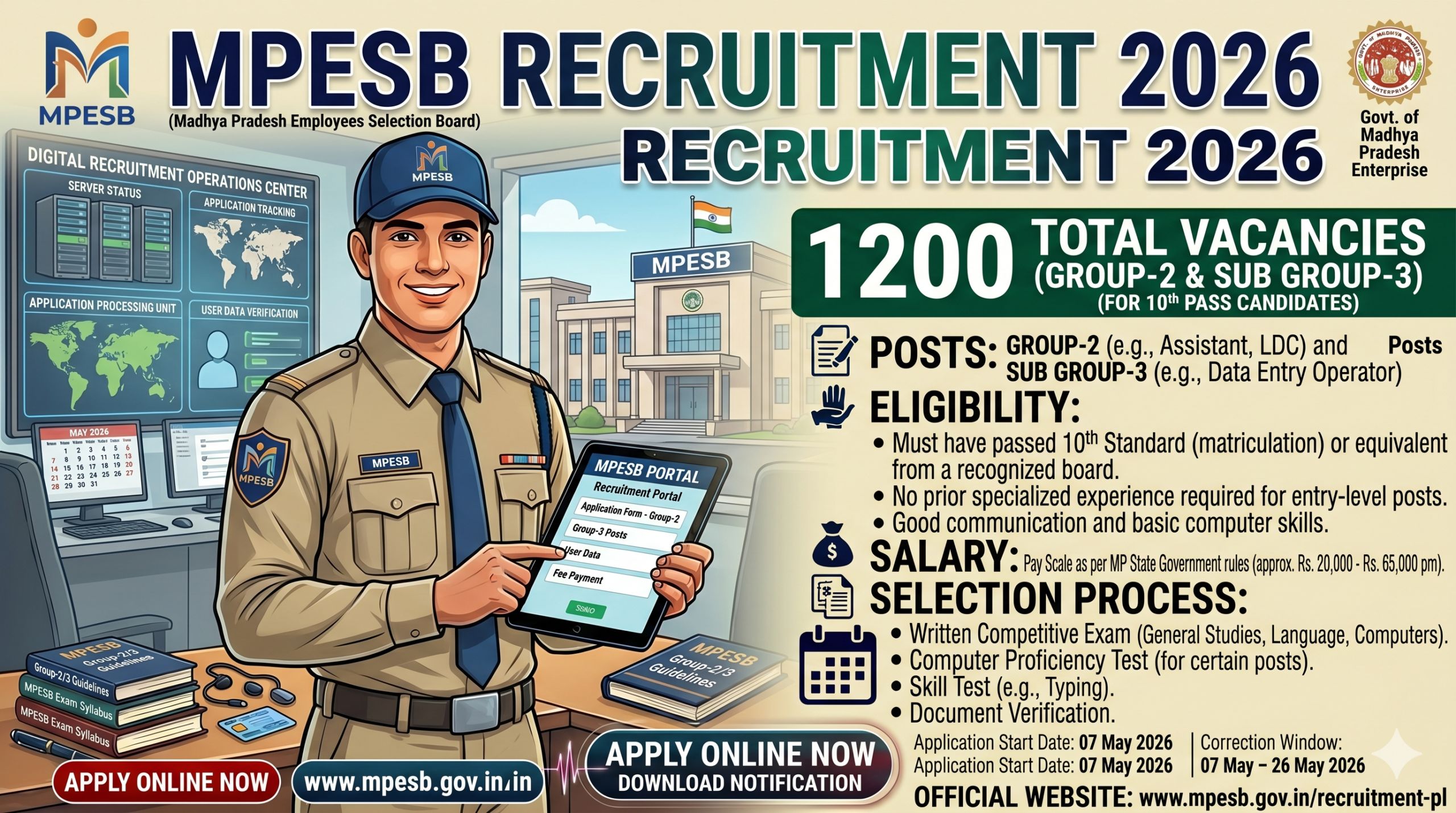
The Madhya Pradesh Employees Selection Board (MPESB), Bhopal (formerly known as MP VYAPAM), officially announced the recruitment drive to fill 1,200 vacancies under the Group-2 (Sub Group-3) Combined Recruitment Framework. The recruitment covers technical and administrative roles including Sanitation Inspector, Lab Technician, Chemist, and related state department cadres.
Selection is conducted through a competitive 200-mark single-stage online examination followed by document verification and medical fitness assessment.
📌 MPESB Group 2 Sub Group 3 Recruitment 2026: Key Overview
| Parameter | Details |
|---|---|
| Recruiting Agency | Madhya Pradesh Employees Selection Board (MPESB) / MP Vyapam |
| Exam Cadre | Group-2 (Sub Group-3) Combined Recruitment Test 2026 |
| Post Names | Sanitation Inspector, Lab Technician, Chemist, Research Assistant, etc. |
| Total Vacancies | 1,200 Posts |
| Educational Qualification | Class 12th + Relevant Diploma / B.Sc. Degree (Post-wise) |
| Age Limit | 18 to 40 Years (General) | Up to 45 Years (Reserved / MP Domicile) |
| Pay Scale Matrix | Pay Level 5 to Level 9 (₹19,500 – ₹62,000) + MP Govt Allowances |
| Selection Mode | Online Written Examination (200 Marks) + Document Verification |
| Application Fee | ₹500 (UR) | ₹250 (SC/ST/OBC/EWS – MP Domicile) + Portal Charges |
| Official Website | esb.mp.gov.in |
📅 Official Recruitment Timeline
| Recruitment Phase | Official Schedule |
|---|---|
| Official Notification Release Date | April 28, 2026 |
| Online Application Start Date | May 07, 2026 |
| Closing Date for Submission of Online Application | May 21, 2026 |
| Application Form Correction Window | May 07, 2026 to May 26, 2026 |
| Written Examination Date | June 24, 2026 |
🏢 Category-Wise Vacancy Breakdown
The 1,200 Group-2 Sub Group-3 vacancies are distributed across categories per Madhya Pradesh state reservation mandates:
| Category Name | Allocated Vacancies |
|---|---|
| Unreserved (UR / General) | 324 |
| Other Backward Classes (OBC) | 324 |
| Scheduled Tribe (ST) | 240 |
| Scheduled Caste (SC) | 192 |
| Economically Weaker Section (EWS) | 120 |
| Total Vacancies | 1,200 Posts |
🎓 Post-Wise Educational Eligibility Criteria
Candidates must fulfill specific academic and diploma requirements matching their target post code on or before the application cutoff date:
- Sanitation Inspector (Swachhata Nirikshak): B.Sc. Degree in Chemistry/Biology from a recognized University + Diploma in Sanitation / Public Health Hygiene.
- Lab Technician / Chemist: B.Sc. in Chemistry / Biochemistry / Medical Laboratory Technology (BMLT) or DMLT diploma recognized by MP Paramedical Council.
- Technical Assistant / Research Cadres: Graduate Degree in relevant science streams (B.Sc. Agriculture / Chemistry / Physics) depending on specific department requisitions.
- MP Employment Registration: Active registration on the MP State Employment Portal (MPRojgar –
rojgar.mahashram.gov.in) is mandatory for candidates claiming state quota benefits.
🔞 Age Limit Criteria & Upper Age Relaxations (As of 01 January 2026)
- Minimum Age Limit: 18 Years
- Maximum Age Limit (Unreserved Male): 40 Years
- Maximum Age Limit (Reserved Categories / All Female Candidates – MP Domicile): 45 Years
Category-Wise Upper Age Relaxations (MP Domicile Only)
| Category | Upper Age Relaxation | Effective Maximum Age |
|---|---|---|
| Unreserved Male Candidates | No Relaxation | 40 Years |
| SC / ST / OBC / EWS (MP Domicile) | 5 Years | 45 Years |
| Female Candidates (All Categories) | 5 Years | 45 Years |
| Persons with Benchmark Disabilities (PwBD) | 5 Years | 45 Years |
💰 Salary Scale & Pay Matrix
Group-2 Sub Group-3 positions fall under Pay Level 5 to Level 9 of the MP State Pay Matrix (7th CPC):
- Pay Scale Range: ₹19,500 – ₹62,000 / ₹25,300 – ₹80,500 depending on post cadre.
- In-Hand Monthly Compensation: Approximately ₹25,000 to ₹40,000 per month (including prevailing MP state Dearness Allowance, HRA based on city tier, and medical allowances).
⚙️ Written Exam Pattern & Evaluation Scheme
The MPESB Group-2 Sub Group-3 examination is a single 200-mark computer-based test (CBT) lasting 3 hours. There is no negative marking penalty for wrong answers.
| Paper Section | Subject Scope | Questions / Marks |
|---|---|---|
| Part A (Common Knowledge) | General Knowledge (MP GK Focus), General Hindi, General English, General Mathematics, General Science, General Computer Knowledge, General Reasoning Ability | 100 Questions / 100 Marks |
| Part B (Domain Technical) | Domain-Specific Subject Knowledge (Post-wise Technical Discipline / B.Sc. / Sanitation / Lab Syllabus) | 100 Questions / 100 Marks |
| Total | Single CBT Paper (3 Hours Duration) | 200 Questions / 200 Marks |
💳 Application Fee Structure
| Candidate Category | Application Processing Fee |
|---|---|
| Unreserved / General / Out-of-State Candidates | ₹500/- (+ MP Kiosk Portal Charge ₹60) |
| SC / ST / OBC / EWS / PwBD (MP Domicile Only) | ₹250/- (+ MP Kiosk Portal Charge ₹60) |
📄 Mandatory Documents Checklist
Keep original and self-attested copies ready for post-examination verification rounds:
- Class 10th Marksheet & Passing Certificate (Proof of Date of Birth).
- Class 12th Marksheet and Higher Graduation Degree / Diploma Marksheets.
- Sanitation / Paramedical / Technical Diploma Pass Certificates.
- MP State Employment Exchange (MP Rojgar) Live Registration Certificate.
- MP Domicile Certificate (Nivas Praman Patra).
- Caste Certificate (SC/ST/OBC Non-Creamy Layer/EWS) issued by competent MP authorities.
- Valid Photo ID Proof (Aadhaar Card, Voter ID, or Driving License).
- Printed Confirmation Copy of MPESB Online Application Form and Fee Receipt.
📝 Step-by-Step Guide: How Online Application Worked
- Visited the official MPESB portal at esb.mp.gov.in or MP Online Portal (
mponline.gov.in). - Completed Profile Registration (MPESB Candidate Profile) and verified Aadhaar e-KYC credentials.
- Accessed Group-2 (Sub Group-3) Combined Recruitment Test 2026 link.
- Selected target post codes and entered academic aggregate marks and MP Employment Registration numbers.
- Uploaded scanned photo, signature, and handwritten declaration as per MPESB template parameters.
- Paid the application processing fee online via Net Banking, Debit/Credit Cards, or MP Online Kiosk.
- Submitted the form and saved the Application Registration Number summary page for future reference.
⚠️ Frequently Asked Questions (FAQs)
1. Is there any negative marking in the MPESB Group-2 Sub Group-3 exam?
No. There is no negative marking deduction for incorrect answers in the MPESB written examination.
2. Can candidates from states other than Madhya Pradesh apply?
Yes. Out-of-state candidates can apply under the Unreserved (UR / Open) category. However, they must pay full application fees (₹500) and cannot claim state reservation relaxations.
3. What is the minimum educational qualification for MPESB Group-2 Sub Group-3 posts?
Qualifications vary by post code, requiring at least Class 12th with a relevant diploma (such as Sanitation / Public Health Hygiene) or a B.Sc. Degree in Chemistry/Biology/Lab Technology.
4. Is MP Employment Portal (Rojgar Registration) mandatory?
Yes. Candidates must possess active registration on the MP State Employment Portal at the time of document verification.
Disclaimer: Govt Result Alert is an independent educational news portal providing updates on public sector recruitments. We are not officially affiliated with the Madhya Pradesh Employees Selection Board (MPESB) or the Government of MP. Candidates are advised to cross-verify all official notices directly at esb.mp.gov.in.
📊 Expert Cutoff Analysis & Preparation Strategy for MPESB Group 2 Sub Group 3
Based on our editorial analysis of previous recruitment cycles and increasing competition trends, candidates must aim for safe target scores rather than merely clearing the minimum qualifying benchmark:
- Expected Safe Target: General/UR candidates should target 78%–84% marks in the written examination, while OBC/EWS aspirants should aim for 74%–80%.
- Focus Areas: Prioritize high-scoring sections such as General Intelligence & Reasoning and Quantitative Aptitude. Daily revision of static General Awareness and current affairs from the past 6 months is essential.
- Time Management: Practice with full-length sectional and mock tests strictly in timed exam conditions to improve accuracy and eliminate negative marking errors.

Ram Avtar is the Founder and Lead Career Analyst at Govt Results Alert. With over 6 years of experience analyzing Government Recruitment Notifications, SSC, Banking, and Railway examination patterns, he leads our fact-checking team to deliver authentic, timely, and verified job alerts directly from official government gazettes.