
⚠️ Important Notice: The online application process for the MPPSC State Civil Services Preliminary Exam 2026 is currently closed. This page serves as a permanent reference guide detailing the complete syllabus, pattern, eligibility criteria, and post hierarchy for aspirants preparing for current and upcoming MPPSC recruitment cycles.
The Madhya Pradesh Public Service Commission (MPPSC) conducts the State Civil Services Examination annually to recruit eligible candidates for prestigious Class II Gazetted and Group B administrative positions. Popularly known as MPPSC PCS, this exam provides a gateway to elite posts such as Deputy Collector, Deputy Superintendent of Police (DSP), Commercial Tax Officer, and Block Development Officer across Madhya Pradesh state departments.
Whether you are analyzing previous cycle trends or preparing for upcoming notifications, this comprehensive guide covers everything from deep-dive syllabus breakdowns and dynamic salary structures to micro-eligibility criteria and physical standards.
📌 MPPSC PCS 2026: Key Overview
| Parameter | Details |
|---|---|
| Conducting Body | Madhya Pradesh Public Service Commission (MPPSC) |
| Exam Name | State Civil Services Examination (MPPSC PCS) |
| Job Location | Madhya Pradesh |
| Cadre Posts | Deputy Collector, DSP, Naib Tehsildar, Commercial Tax Officer, etc. |
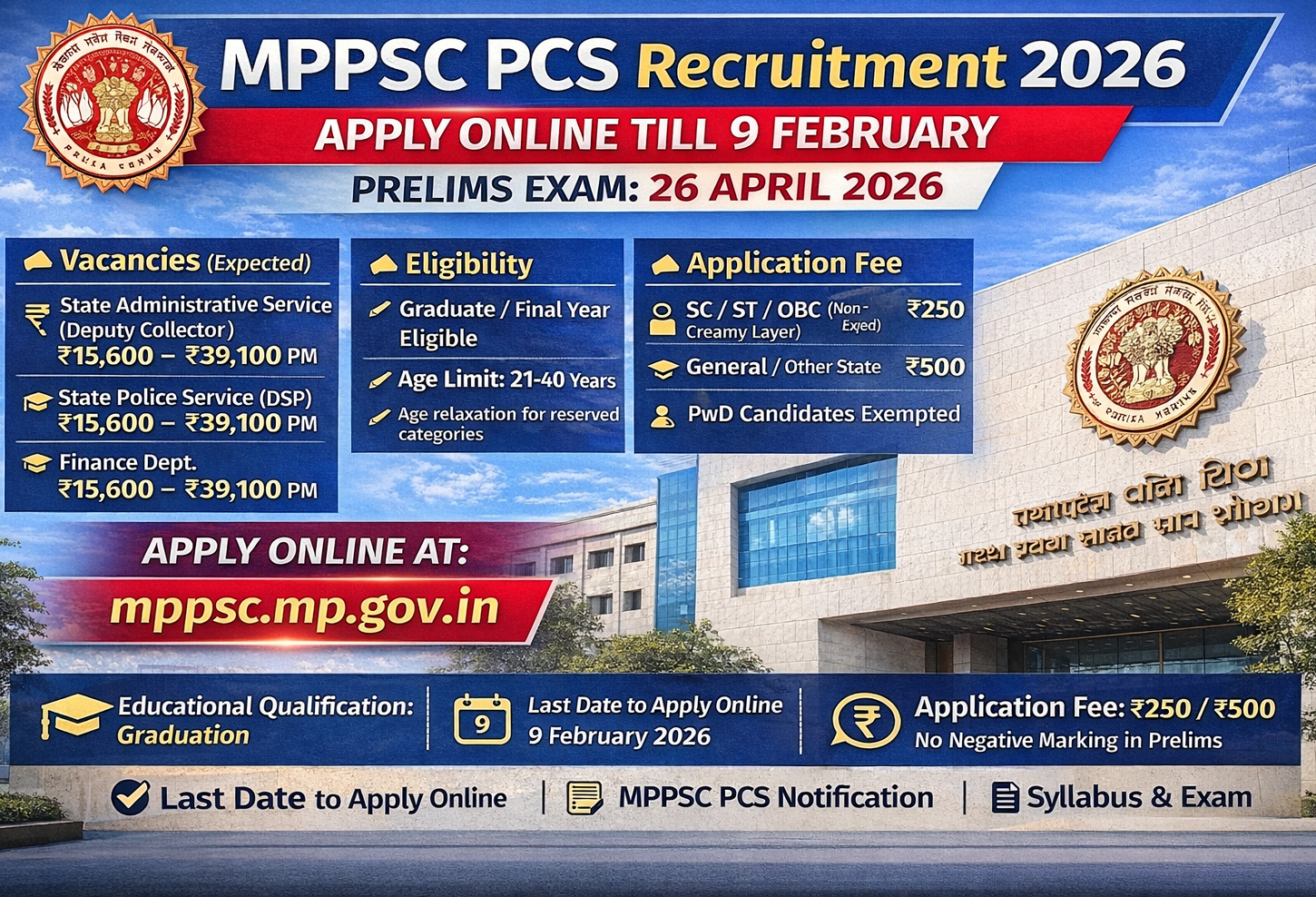
| Educational Qualification | Bachelor’s Degree in any discipline from a recognized University |
| Age Limit | 21 to 40 Years (Category relaxations applicable) |
| Selection Strategy | Prelims Exam (MCQs) + Mains Exam (Descriptive) + Interview |
| Pay Scale | ₹15,600 – ₹39,100 (Group A) | ₹9,300 – ₹34,800 (Group B) |
| Official Portal | mppsc.mp.gov.in |
📅 MPPSC PCS 2026: Historical Recruitment Timeline
Below is the reference schedule followed during the 2026 MPPSC State Civil Services Examination cycle:
| Recruitment Phase | Official Timeline |
|---|---|
| Official Notification Release | January 2026 |
| Online Application Window | 10 January 2026 to 9 February 2026 |
| Admit Card Download Window | 16 April 2026 Onwards |
| Preliminary Examination Date | 26 April 2026 |
| Mains Examination & Interview Schedule | Notified Post Prelims Results |
💼 Post Profiles, Pay Scale & Career Progression
Positions offered through the MPPSC PCS are categorized into Class II Gazetted Officers (Group A) and Executive/Support Posts (Group B).
1. Group A / Class II Gazetted Profiles (Pay Scale: ₹15,600 – ₹39,100 + Grade Pay)
- State Administrative Service (Deputy Collector): Functions as Sub-Divisional Magistrate (SDM), overseeing land revenue administration, law and order maintenance, and district development.
- State Police Service (Deputy Superintendent of Police – DSP): Direct entry into law enforcement hierarchy, leading circle crime prevention, security management, and police station supervision.
- Finance & Accounts Service: Manages state treasuries, audits, financial planning allocations, and budget regularizations.
- Commercial Tax Officer & District Registrar: Handles state revenue collections, GST compliance tracking, and property registrations.
2. Group B Portfolios (Pay Scale: ₹9,300 – ₹34,800 + Grade Pay)
- Naib Tehsildar (Revenue Department): Handles local land records, dispute resolution, public grievances, and grassroots revenue collection.
- Assistant Development Block Officer (ADPO): Executes rural development initiatives and government welfare schemes.
- Assistant Treasury Officer: Maintains departmental accounts, verifies expenditure balances, and processes state transactions.
Perks and Allowances
In addition to basic pay, MPPSC officers receive standard state government benefits:
- Dearness Allowance (DA) with periodic revisions.
- House Rent Allowance (HRA) or official government accommodation.
- Comprehensive medical coverage for self and dependent family members.
- Official vehicle and security guards for field-heavy administrative roles (SDM, DSP).
🎓 Detailed Eligibility Criteria
1. Educational Qualifications
- Mandatory Qualification: Must hold a Bachelor’s Degree in any field from a UGC-recognized university or institution.
- Final Year Applicants: Candidates in their final year of graduation are provisionally eligible to attempt Prelims, but must produce their final passing marksheet before appearing for the Mains Descriptive Examination.
- Percentage Requirement: No minimum percentage limit is required; a passing degree fulfills the eligibility criteria.
2. Age Limits & Relaxations (As on Cutoff Date)
- Non-Uniform Posts (General/Unreserved): Minimum 21 Years | Maximum 40 Years
- Uniformed Posts (DSP, District Commandant): Minimum 21 Years | Maximum 33 Years
| Category (MP Domicile) | Upper Age Relaxation | Effective Max Age |
|---|---|---|
| General / Out-of-State Candidates | No Relaxation | 40 Years |
| SC / ST / OBC (Non-Creamy Layer) | 5 Years | 45 Years |
| Women Candidates (All Categories) | 5 Years | 45 Years |
| Persons with Disabilities (PwD) | 5 Years | 45 Years |
Note: Candidates from outside Madhya Pradesh are considered under the Unreserved (General) category regardless of their caste status in their home states.
🏆 Three-Tier Selection Architecture
- Stage 1: Preliminary Examination (Screening Test)Consists of two objective papers (200 marks each) conducted on the same day. Paper I (GS) determines the cutoff for Mains entry. Paper II (CSAT) is qualifying in nature (33% for General, 30% for reserved categories). There is no negative marking in MPPSC Prelims.
- Stage 2: Main Examination (Written Descriptive Test)A comprehensive written exam comprising compulsory descriptive papers on General Studies, Ethics, Hindi Language, and Essay Writing. Optional subjects are not part of the MPPSC Mains curriculum.
- Stage 3: Personality Test (Interview Round)A panel assessment evaluating administrative aptitude, leadership traits, and critical problem-solving skills. Final merit rankings are based on combined Mains + Interview scores.
📘 Complete MPPSC Prelims Syllabus Breakdown
Paper I: General Studies (GS)
- History, Culture & Literature of Madhya Pradesh: Important dynasties, tribal heritage, folk arts, freedom movement in MP, and prominent literary figures.
- History of India: Ancient, Medieval, and Modern Indian History, with focus on the National Freedom Movement and post-independence consolidation.
- Geography of MP & World/India: Physical geography, climate zones, river systems, natural resources, wildlife sanctuaries, and agricultural patterns.
- Constitutional & Administrative Structure of MP & India: Indian Constitution, Parliament, Judiciary, Panchayati Raj systems, and Governance in MP.
- Economy of India & Madhya Pradesh: Economic development, industrial growth, banking systems, demographic indicators, and state budgets.
- General Science & Technology: Basic physical/life sciences, environmental conservation, ICT, robotics, cybersecurity, and e-governance.
Paper II: General Aptitude Test (CSAT)
- Comprehension & Textual Interpretation
- Interpersonal & Communication Skills
- Logical Reasoning & Analytical Ability
- Decision Making & Administrative Problem Solving
- Basic Numeracy & Data Interpretation (Class 10 Level)
- General Hindi Language Comprehension (Class 10 Level)
⚠️ Frequently Asked Questions (FAQs)
1. Can candidates from other states apply for MPPSC Civil Services?
Yes. Candidates from all Indian states are eligible to apply. However, non-MP domicile candidates are treated under the Unreserved (General) category and cannot claim state reservation benefits.
2. Is there any negative marking in the MPPSC Prelims examination?
No, MPPSC Prelims does not have negative marking. Candidates can attempt all 100 questions in each paper without penalty for incorrect answers.
3. Are there optional subjects in the MPPSC Mains examination?
No, MPPSC has removed optional subjects from the Mains exam framework. All candidates appear for common compulsory General Studies and Hindi language papers.
4. What is the minimum age required to apply for MPPSC PCS?
The minimum age required is 21 years as on the official calculation cutoff date.
Disclaimer: Govt Result Alert is an independent educational portal providing syllabus and recruitment news updates. We are not officially affiliated with the Madhya Pradesh Public Service Commission (MPPSC). Candidates are advised to cross-verify official updates at mppsc.mp.gov.in.
📊 Expert Cutoff Analysis & Preparation Strategy for MPPSC PCS
Based on our editorial analysis of previous recruitment cycles and increasing competition trends, candidates must aim for safe target scores rather than merely clearing the minimum qualifying benchmark:
- Expected Safe Target: General/UR candidates should target 78%–84% marks in the written examination, while OBC/EWS aspirants should aim for 74%–80%.
- Focus Areas: Prioritize high-scoring sections such as General Intelligence & Reasoning and Quantitative Aptitude. Daily revision of static General Awareness and current affairs from the past 6 months is essential.
- Time Management: Practice with full-length sectional and mock tests strictly in timed exam conditions to improve accuracy and eliminate negative marking errors.

Ram Avtar is the Founder and Lead Career Analyst at Govt Results Alert. With over 6 years of experience analyzing Government Recruitment Notifications, SSC, Banking, and Railway examination patterns, he leads our fact-checking team to deliver authentic, timely, and verified job alerts directly from official government gazettes.