
THE STORY BEHIND THIS RECRUITMENT — WHY IFS IS DIFFERENT FROM EVERY OTHER UPSC SERVICE
Most people who know about UPSC know about the Civil Services Examination — the path to IAS, IPS, IFS (Foreign Service), and around 24 other central services. What fewer people fully understand is that the Indian Forest Service runs on a parallel track within the UPSC framework, sharing the Preliminary examination but diverging completely at the Mains stage into a fundamentally different kind of examination designed for a fundamentally different kind of career.
Understanding this distinction is the starting point for investigating whether IFS is the right pursuit for you.
The Indian Forest Service is not an administrative service in the IAS mold — where officers move through postings across development projects, revenue administration, district management, and policy implementation. IFS officers are specifically assigned to India’s forest management system: managing reserved forests, national parks, tiger reserves, wildlife sanctuaries, and biodiversity conservation programs across 21.71% of India’s total land area that is under official forest cover.
In practice, this means IFS officers spend meaningful career time in genuine field environments — remote forest divisions, wildlife corridors, tribal interface zones — in ways that desk-bound administrative services do not. It also means the examination’s specialized optional subject structure requires candidates to have genuine scientific or technical depth in forestry-adjacent disciplines, not the broad humanities and social science base that dominates IAS preparation.
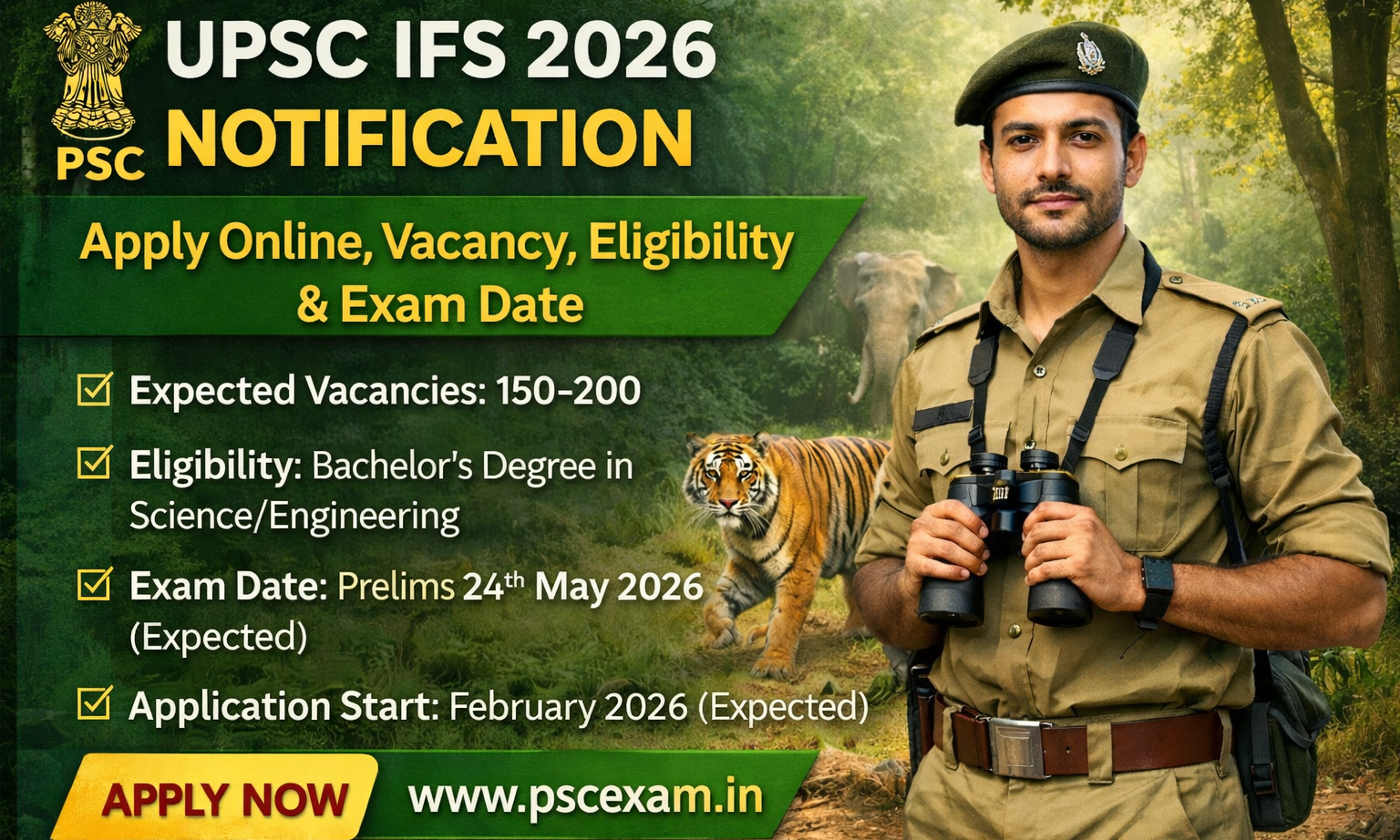
UPSC IFS 2026 is expected to announce 150 to 200 vacancies when the official notification releases. Preliminary examination is scheduled for May 24, 2026 — the same date as UPSC Civil Services Preliminary, since both examinations share the same Prelims paper. Applications are expected to have been open since approximately February 2026.
WHAT THE NUMBERS REALLY SHOW — THE COMPETITION LANDSCAPE FOR IFS
150 to 200 vacancies expected. These are comparatively modest numbers against the Civil Services’ 1,100+ vacancy announcements, but they draw a meaningfully different and smaller eligible applicant pool — because the eligibility requirements for IFS specifically restrict applicants to those with science, agriculture, or engineering degree backgrounds.
A candidate with a BA in History, Political Science, or any humanities discipline cannot apply for IFS regardless of their UPSC preparation depth or Civil Services rank. The eligible disciplines explicitly required — Botany, Zoology, Chemistry, Physics, Mathematics, Statistics, Geology, Forestry, Agriculture, Agricultural Engineering, Civil Engineering, Mechanical Engineering, Chemical Engineering, Animal Husbandry and Veterinary Science — form a naturally narrower educational base than the entirely open eligibility of the Civil Services Examination.
This creates the IFS competition dynamic: fewer total applicants than Civil Services, but candidates who are applying have specific scientific credentials that filter out the humanities-heavy Civil Services applicant pool entirely. The remaining pool is still competitive — engineering and science graduates represent a large fraction of India’s college-educated population, and IFS remains highly prestigious.
The critical investigative point: IFS selection ratio is determined within the science-eligible applicant pool specifically. A strong Physics or Botany graduate who finds the humanities-heavy Civil Services General Studies syllabus difficult may find IFS’s science-oriented structure actually better aligned to their strengths — making competitive odds comparatively more favorable for this specific profile of candidate.
WHO ACTUALLY QUALIFIES — THE EDUCATIONAL ELIGIBILITY INVESTIGATION
The educational eligibility for IFS is one of the more specific eligibility frameworks in any UPSC examination, and understanding it precisely matters before committing preparation time.
Eligible Disciplines:
Pure Sciences — Botany, Zoology, Chemistry, Physics, Mathematics, Statistics, Geology: Standard undergraduate science degrees in these disciplines from recognized universities qualify directly. This covers a large portion of BSc graduates across India.
Agriculture and Related Sciences — Agriculture, Forestry, Animal Husbandry and Veterinary Science: Degrees specifically in these fields are eligible, which makes IFS particularly natural for BSc Agriculture or BSc Forestry graduates who have spent their entire undergraduate program studying content directly relevant to what IFS officers actually manage.
Engineering Disciplines — Civil, Mechanical, Chemical, Agricultural Engineering: BE/BTech graduates in these disciplines are eligible, expanding the potential applicant pool to include the large engineering graduate cohort of India while still maintaining the scientific/technical eligibility requirement that excludes humanities.
What Is Not Eligible:
Any degree primarily in humanities, social sciences, commerce, management, or other non-scientific disciplines. This is absolute — even if a candidate also has a science minor or has done science subjects at 12th level, if their graduation degree is not in one of the specified disciplines, they are ineligible for IFS.
Age Limit (calculated as on August 1, 2026):
General: 21 to 32 years. OBC: 21 to 35 years. SC/ST: 21 to 37 years. Ex-Servicemen: 21 to 37 years. PwBD: 21 to 42 years.
The 32-year General category maximum is the same as UPSC Civil Services, and attempt limits follow UPSC’s civil services rules — verify the specific attempt limit applicable to IFS in the official notification.
THE MONEY AND CAREER STRUCTURE — WHAT BECOMING AN IFS OFFICER ACTUALLY MEANS
Unlike PSU or state government recruitments where salary is the primary career metric, IFS officer careers are better understood through their complete structure — because the combination of central service status, field posting culture, and specialized career progression is what makes this service distinctive.
The application fee of just ₹100 for General/OBC/EWS male candidates, with women, SC/ST, and PwBD candidates fully exempted, reflects UPSC’s standard fee structure across its examinations — nominal rather than reflective of actual career value.
IFS officers start at the Forest Range Officer level after training at the Indira Gandhi National Forest Academy (IGNFA) in Dehradun — an intensive training program that covers forestry science, wildlife management, administrative law, and physical fieldwork before formal posting. The salary follows Central Service Group A pay scales under the 7th Pay Commission — starting basic pay in the ₹56,100 range at Level 10, with total compensation including DA, HRA, and other allowances producing effective monthly income comparable to other Group A central services.
The career progression through Forest Range Officer, Divisional Forest Officer, Conservator of Forests, Chief Conservator of Forests, to Principal Chief Conservator of Forests/Head of Forest Force at the state level, and through various central deputation options, offers a structured advancement ladder with genuine authority and responsibility at each level.
But the most distinctive element of an IFS career that candidates investigating this option should understand is the field component. Unlike most central government services where field exposure is episodic and desk work dominates, IFS posting cycles routinely involve actual forest divisions — remote locations in tiger reserves, hill stations, tribal belt forests, and coastal mangrove areas where the work of forest management, wildlife protection, and anti-poaching operations happens in physical environments, not meeting rooms.
For candidates who specifically want a government career with genuine environmental work and field exposure — not a desk-administrative career that happens to be in the environment ministry — IFS offers something most other government services cannot.
THE PROCESS NOBODY EXPLAINS PROPERLY — HOW IFS SELECTION ACTUALLY DIFFERS FROM CIVIL SERVICES
The IFS examination shares its Preliminary with the Civil Services Examination — on May 24, 2026 — but this shared Prelims is where the similarity largely ends.
Preliminary Examination — Shared With Civil Services
Both papers of the Civil Services Prelims are also the IFS Prelims:
Paper I (General Studies): 200 marks, objective, merit-based for ranking. This paper covers current events, Indian history and culture, geography, governance and polity, economic and social development, and environmental ecology and biodiversity. For IFS specifically, the environmental and ecology portion of General Studies is particularly relevant — and candidates from science backgrounds often find this section more naturally accessible than humanities graduates do.
Paper II (CSAT): 200 marks, qualifying at 33% — your CSAT score does not count toward final ranking, only whether you meet the 33% qualifying threshold.
A candidate who is simultaneously preparing for both Civil Services and IFS can share their Prelims preparation completely — the same Prelims paper is used for both.
Main Examination — Where IFS Diverges Completely
This is where IFS becomes a different examination entirely. Six papers, each 250 marks, 3 hours:
General English: Tests written English ability — comprehension, essay, and language proficiency. This is the one non-science paper in the IFS Mains.
General Knowledge: India and international affairs, environment, governance — descriptive format requiring written analytical ability.
Optional Subject Paper I and Paper II (First Subject): You choose one optional subject from the approved list and answer two papers on it.
Optional Subject Paper I and Paper II (Second Subject): You choose a second optional subject and answer two papers on it.
The approved optional subjects are: Agriculture, Botany, Chemistry, Animal Husbandry and Veterinary Science, Geology, Mathematics, Physics, Statistics, Zoology, Forestry, Agricultural Engineering, Civil Engineering, Mechanical Engineering, Chemical Engineering.
The Optional Subject Decision — The Most Important Strategic Choice in IFS Preparation
Choosing your two optional subjects is the single most consequential decision in your IFS preparation journey. Unlike Civil Services where optionals are chosen from a much broader list including humanities, IFS optionals are entirely science and engineering disciplines. This is both limiting and advantageous — limiting because you cannot choose subjects outside your scientific domain, advantageous because you are being tested on areas where your academic background should provide genuine preparation foundation.
The natural strategy: choose optionals closest to your undergraduate degree. A Botany BSc graduate choosing Botany and Zoology as optionals is working from foundational knowledge. An Agricultural Engineering BE graduate choosing Agricultural Engineering and Agriculture is in similar territory. Choosing subjects with no connection to your educational background — even if they are on the allowed list — creates a preparation mountain that your actual background candidates for the same subject will have been climbing for years.
Forestry as an optional deserves specific mention: it is specifically relevant to what IFS officers actually do, and study material for Forestry optional preparation is more specialized but more directly applicable to the career than, say, Mathematics or Statistics optionals, which are academically neutral to the actual forest service work.
Personality Test / Interview — 275 Marks
Candidates who clear Mains are called for interview. 275 marks for IFS interview is proportionally significant — the interview carries meaningful weight in final merit.
IFS interview panels specifically probe environmental awareness, forest policy knowledge, wildlife management familiarity, and the candidate’s genuine commitment to a career involving field postings in remote and challenging environments. A candidate who demonstrates deep environmental engagement, knowledge of current forest cover data, wildlife protection case studies, and India’s international environmental commitments consistently performs better than candidates who prepared only academic content without staying current on the actual policy and field reality of Indian forestry.
WHAT THE OPTIONAL SUBJECTS ACTUALLY REQUIRE — A SUBJECT-BY-SUBJECT HONEST ASSESSMENT
For candidates trying to decide their optionals, here is the honest picture:
Botany and Zoology together cover the natural science foundation of forestry — plant systematics, ecology, wildlife biology, taxonomy, physiology. For BSc Biology or Botany/Zoology graduates, this combination builds directly on undergraduate preparation. The overlap with environmental content also makes Prelims General Studies preparation synergistic.
Agriculture has extensive study material, a large aspirant community, and direct relevance for Agriculture graduates. Agricultural practices, soil science, crop production, plant pathology — substantial content depth but accessible if you have the degree background.
Forestry as an optional is possibly the most directly relevant to IFS work but has a smaller preparation community and fewer coaching resources. Candidates who choose Forestry typically have BSc Forestry or related backgrounds and are specifically committed to understanding the science of what they will actually manage as officers.
Engineering optionals (Civil, Mechanical, Chemical, Agricultural Engineering) require genuinely postgraduate-level engineering content in the Mains papers. These are viable for engineering graduates who have strong academic foundations and can extend undergraduate knowledge to the exam’s required depth, but should not be chosen lightly.
Mathematics, Physics, Chemistry, Statistics, Geology are academically rigorous options that reward genuinely strong disciplinary background but are challenging to prepare from scratch.
HOW TO APPLY — STEP BY STEP
Visit upsconline.nic.in and click on “Online Application for Various Examinations.” Select IFS Examination 2026.
Complete Part-I registration — name, date of birth, email, mobile number. Note your registration ID.
Complete Part-II registration — educational qualification details including your specific eligible degree and discipline, choice of two optional subjects, preferred examination centers, and all personal details.
Upload your photograph, signature, and valid photo ID in the specified formats.
Pay ₹100 through online mode if you are a General/OBC/EWS male candidate. Women, SC/ST, and PwBD candidates are fee-exempt.
Review every detail before final submission — optional subject selection cannot typically be changed after submission. Submit and download your confirmation page.
SHOULD YOU PURSUE IFS — HONEST SELF-ASSESSMENT FRAMEWORK
Pursue IFS seriously if: Your graduation is in an eligible science, agriculture, or engineering discipline; you have genuine interest in environmental conservation, forestry, or wildlife work rather than just seeking a prestigious government job; you are comfortable with the idea of career postings in field environments including remote forest areas; and your academic background naturally aligns with at least two of the allowed optional subjects.
Consider carefully before committing if: Your motivation is primarily “UPSC prestige” without specific interest in the environmental sector; your degree is in an eligible discipline but your optional subjects would require starting preparation essentially from scratch; or you strongly prefer urban/metro desk postings, since IFS career trajectory includes significant non-urban posting components.
IMPORTANT DATES
| Event | Tentative Date |
|---|---|
| Notification Release | February 2026 |
| Preliminary Examination | May 24, 2026 |
| Admit Card | 2–3 weeks before Prelims |
| Main Examination | November–December 2026 |
| Personality Test | 2027 (after Mains results) |
QUICK REFERENCE
| Detail | Information |
|---|---|
| Conducting Body | UPSC |
| Examination | Indian Forest Service (IFS) 2026 |
| Expected Vacancies | 150–200 (tentative) |
| Eligible Disciplines | Science, Agriculture, Engineering (specific list) |
| Age | 21–32 General (relaxation for reserved) |
| Application Fee | ₹100 General/OBC/EWS Male (others exempt) |
| Prelims Date | May 24, 2026 (shared with Civil Services Prelims) |
| Mains | 6 papers, 250 marks each |
| Interview | 275 marks |
| Selection | Prelims + Mains + Interview |
Official Website: upsconline.nic.in
Disclaimer: Vacancy numbers and dates are tentative pending official UPSC notification. Always verify confirmed details from upsconline.nic.in. This article is for informational purposes only.
📊 Expert Cutoff Analysis & Preparation Strategy for UPSC IFS 2026 — Indian Forest Service Exam, 150-200 Expected Vacancies, Prelims on May 24
Based on our editorial analysis of previous recruitment cycles and increasing competition trends, candidates must aim for safe target scores rather than merely clearing the minimum qualifying benchmark:
- Expected Safe Target: General/UR candidates should target 78%–84% marks in the written examination, while OBC/EWS aspirants should aim for 74%–80%.
- Focus Areas: Prioritize high-scoring sections such as General Intelligence & Reasoning and Quantitative Aptitude. Daily revision of static General Awareness and current affairs from the past 6 months is essential.
- Time Management: Practice with full-length sectional and mock tests strictly in timed exam conditions to improve accuracy and eliminate negative marking errors.

Ram Avtar is the Founder and Lead Career Analyst at Govt Results Alert. With over 6 years of experience analyzing Government Recruitment Notifications, SSC, Banking, and Railway examination patterns, he leads our fact-checking team to deliver authentic, timely, and verified job alerts directly from official government gazettes.