
Best Government Jobs and Career Paths After 12th Pass
Completing the 12th standard (Intermediate) is a major milestone in every student’s life. While many choose to pursue higher education, a large number of aspirants seek immediate career stability through government jobs. The Central and State Governments of India release thousands of vacancies every year specifically for candidates who have passed the 12th standard. These jobs offer excellent starting salaries, job security, medical benefits, and structured promotion pathways. This guide details the top 5 government career options available immediately after completing school.
1. Comparison of the Top 5 Government Jobs
To help you choose the right path, refer to this detailed comparative table highlighting salaries, eligibility, and administrative boards:
| Job Designation | Conducting Authority | Key Roles & Posts | Salary Grade & In-hand Range |
|---|---|---|---|
| SSC CHSL Exam | Staff Selection Commission | LDC, DEO, Junior Secretariat Assistant | Rs. 28,000 to Rs. 35,000 / Month |
| RRB NTPC (Undergrad) | Railway Recruitment Board (RRB) | Ticket Clerk, Junior Clerk, Typist | Rs. 25,000 to Rs. 32,000 / Month |
| State Police Constable | State Police Recruitment Boards | Police Constable, Driver, Warder | Rs. 22,000 to Rs. 28,000 / Month |
| Defense Force Agniveer | Indian Army, Navy, Air Force | General Duty (GD), Clerk, Technical | Rs. 30,000 to Rs. 40,000 / Month |
| SSC Stenographer (Grade D) | Staff Selection Commission | Stenographer in Central Ministries | Rs. 35,000 to Rs. 45,000 / Month |
2. In-Depth Analysis of Each Career Option
A. SSC CHSL (Combined Higher Secondary Level)
The SSC CHSL is arguably the most popular 12th pass competitive examination in India. It recruits staff for administrative positions in central ministries, departments, and offices. The primary roles are Lower Division Clerk (LDC) and Data Entry Operator (DEO). This job provides a highly professional work environment, standard office hours (9 to 5), and excellent scope for promotions to Section Officer levels over time.
B. Railway NTPC (Non-Technical Popular Categories)
The Indian Railways is one of the largest employers in the world. Under the NTPC undergraduate classification, 12th pass candidates can secure posts like Commercial-cum-Ticket Clerk and Accounts Clerk cum Typist. These roles come with unique perks, including free railway passes for travel across India, comprehensive medical coverage in railway hospitals, and housing allowances.
C. State Police Constable (UP, Delhi, Bihar, Rajasthan)
If you prefer an active lifestyle, law enforcement is an excellent choice. State police departments recruit constables in large numbers. The selection process involves a written test, a physical measurement test, and a physical running test. Police jobs offer a respected social status and additional allowances, though the working hours can be irregular compared to office clerk profiles.
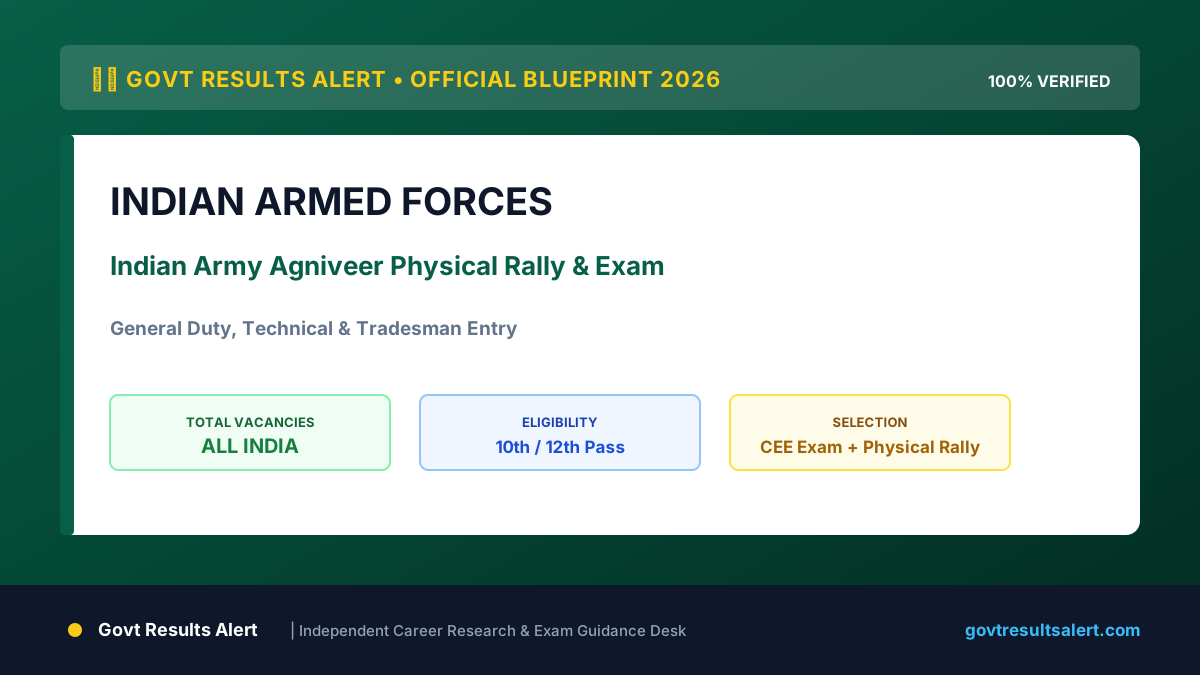
D. Indian Armed Forces (Agniveer Scheme)
Under the Agniveer scheme, young aspirants can join the Indian Army, Navy, or Air Force for a tenure of 4 years. The training is intense and builds exceptional discipline. After 4 years, 25% of the batch is absorbed into the permanent cadre, while the remaining 75% receive a substantial financial package (Seva Nidhi) and reservations in state police forces and central paramilitary forces.
E. SSC Stenographer (Grade D)
This is a specialized exam for candidates who know shorthand typing (stenography). Because the exam pattern does not include a mathematics section, it is a great choice for students from arts or commerce backgrounds. The job involves assisting high-ranking officers and ministers, which translates to a highly prestigious administrative profile. The stenographer grade D functions as a personal assistant, managing scheduling and file reviews for senior executive cadres.
3. Basic Eligibility and Common Prep Strategy
To apply for these jobs, you must have completed the 12th standard from a recognized education board. The age limit is typically 18 to 27 years, with age relaxations for reserved categories.
Since almost all these exams test you on basic English, Mathematics, General Knowledge, and Reasoning, you can prepare for multiple exams simultaneously. Focus on building strong basics in Class 10th level mathematics and develop a daily habit of reading current affairs.
Frequently Asked Questions (FAQs)
Q1. Can arts stream students apply for science-based defense posts?
Arts stream students can apply for General Duty (GD) posts in the Army, but technical defense posts (like Air Force Tech or Navy Technical) require Physics, Chemistry, and Math in the 12th standard.
Q2. What is the physical height limit for Delhi Police Constable?
For male candidates, the minimum height requirement is 170 cm, and for female candidates, it is 157 cm.
Q3. Is computer typing certificate mandatory for SSC CHSL?
You do not need a computer certificate during the application phase, but you must pass the final typing speed test conducted during the skill assessment stage.
Q4. How much is the Seva Nidhi package for Agniveers?
After completing the 4-year service, Agniveers receive a tax-free lump sum package of approximately Rs. 11.71 Lakhs along with accrued interest.
Q5. What is the typing speed required for Clerk posts?
A typing speed of 35 words per minute (wpm) in English or 30 words per minute (wpm) in Hindi on a computer is standard.
Q6. Can I prepare for SSC CHSL and Railway NTPC together?
Yes, the syllabus for both exams is nearly identical, making it easy to prepare for both simultaneously.
Q7. Are there any physical tests for SSC CHSL LDC posts?
No, CHSL clerk posts are purely desk jobs and do not require any physical efficiency or running tests.
Q8. What is the salary of a Delhi Police Constable?
The in-hand salary of a Delhi Police Constable ranges between Rs. 35,000 to Rs. 40,000 per month due to higher city allowances in Delhi.
Q9. What is the minimum age to apply for 12th pass government jobs?
The minimum age is 18 years as of the cut-off date mentioned in the official vacancy notification.
Q10. How can I learn stenography?
You can join a local shorthand institute. It takes about 6 to 8 months of regular practice to reach a speed of 80 words per minute.
Comprehensive Candidate Preparation Checklist
To help you prepare effectively and maximize your chances of success, here is a detailed, step-by-step checklist to follow throughout the recruitment cycle:
- Analyze the complete syllabus: Do not skip any section. Read the topic-wise list in the notification and focus on sections with high weightage.
- Check your eligibility status: Double check the age limit, educational qualification criteria, and regional cut-off parameters before beginning your studies.
- Collect authoritative books: Avoid buying too many books. Focus on standard reference guides recommended by successful candidates and subject experts.
- Establish a daily study schedule: Dedicate 6 to 8 hours daily with short breaks. Allocate specific slots for difficult subjects.
- Write down short summaries: Prepare your own short notes during the initial study phase. These will help you revise the entire syllabus in the final week.
- Practice previous year papers: Solve at least the last 5 years of exam papers to understand the difficulty level and question trends.
- Analyze mock test errors: Keep a dedicated notebook to record questions you solve incorrectly and focus on correcting your conceptual mistakes.
- Improve calculation speed: Memorize tables, cubes, and squares to save time in mathematics and reasoning.
- Ensure proper nutrition and rest: Sleep for at least 7 to 8 hours daily. A healthy mind is essential to handle examination pressure.
- Maintain confidence and focus: Stay positive and consistent in your studies. Regular practice is the key to cracking competitive examinations.
📊 Expert Cutoff Analysis & Preparation Strategy for Top 5 Government Career Options After Passing 12th Standard
Based on our editorial analysis of previous recruitment cycles and increasing competition trends, candidates must aim for safe target scores rather than merely clearing the minimum qualifying benchmark:
- Expected Safe Target: General/UR candidates should target 78%–84% marks in the written examination, while OBC/EWS aspirants should aim for 74%–80%.
- Focus Areas: Prioritize high-scoring sections such as General Intelligence & Reasoning and Quantitative Aptitude. Daily revision of static General Awareness and current affairs from the past 6 months is essential.
- Time Management: Practice with full-length sectional and mock tests strictly in timed exam conditions to improve accuracy and eliminate negative marking errors.

Ram Avtar is the Founder and Lead Career Analyst at Govt Results Alert. With over 6 years of experience analyzing Government Recruitment Notifications, SSC, Banking, and Railway examination patterns, he leads our fact-checking team to deliver authentic, timely, and verified job alerts directly from official government gazettes.