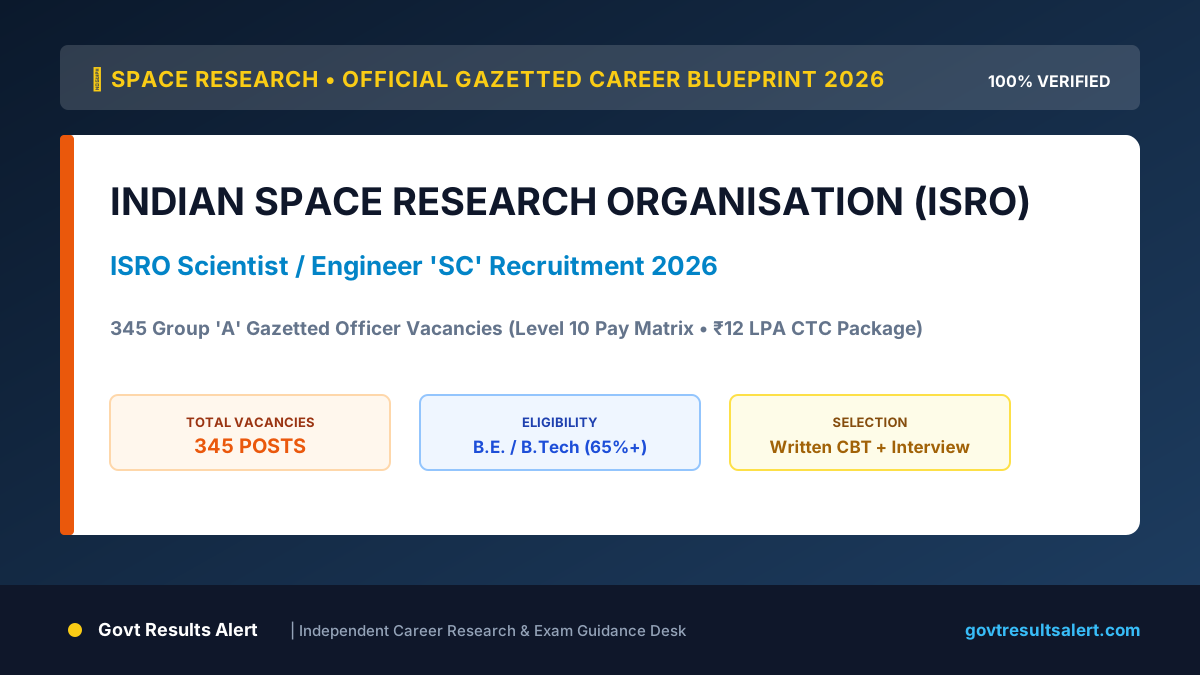
The Indian Space Research Organisation (ISRO) under the Department of Space, Government of India, has officially issued the centralized recruitment notification through the ISRO Centralised Recruitment Board (ICRB) for 345 Scientist/Engineer ‘SC’ (Group ‘A’ Gazetted Officer) vacancies. Spanning disciplines in Electronics, Mechanical, Computer Science, Electrical, and Civil Engineering, these prestigious positions offer engineers the rare privilege of spearheading India’s lunar, planetary, human spaceflight (Gaganyaan), and launch vehicle missions with Pay Level 10 remuneration (approx. ₹12 Lakhs CTC per annum).
Here is an authoritative analysis detailing the discipline-wise vacancy distribution, essential first-class B.E./B.Tech criteria, written test architecture, interview evaluation metrics, and registration instructions.
ISRO Scientist/Engineer 2026: Executive Overview
| Parameter | Official Notification Specifications |
|---|---|
| Organisation | Indian Space Research Organisation (ISRO, Department of Space) |
| Post Designation | Scientist / Engineer ‘SC’ (Group ‘A’ Gazetted Post) |
| Total Openings | 345 Executive Engineering Posts Across Space Centres |
| Deploying Centres | VSSC Thiruvananthapuram, URSC Bengaluru, SDSC SHAR Sriharikota, SAC Ahmedabad, LPSC |
| Pay Matrix & CTC | 7th CPC Pay Level-10 (Basic ₹56,100 – ₹1,77,500 + DA, HRA, Transport Allowance • CTC ~₹12 LPA) |
| Essential Qualification | First Class B.E. / B.Tech / B.Sc (Engg) with minimum 65% aggregate marks or 6.84/10 CGPA |
| Selection Stages | Written Test (80 MCQs) ➔ Comprehensive Technical Interview (50:50 Merit Weightage) |
| Official Portal | www.isro.gov.in/Careers |
Discipline-Wise Vacancy Allocations
| Engineering Discipline | Post Code | Eligible Degree Streams | Total Posts |
|---|---|---|---|
| Electronics Engineering | BE001 | Electronics & Comm / Avionics / Telecommunication | 125 |
| Mechanical Engineering | BE002 | Mechanical / Aerospace / Production / Industrial | 110 |
| Computer Science Engineering | BE003 | Computer Science / Information Technology / Software | 65 |
| Electrical Engineering | BE004 | Electrical & Electronics / Power Systems | 25 |
| Civil Engineering | BE005 | Civil Engineering / Structural Engineering | 20 |
| Grand Total | ICRB 2026 | All Space Centres | 345 |
Eligibility Conditions: Academic & Age Parameters
- Academic Requirement: Full-time B.E. / B.Tech or equivalent degree with First Class and a minimum aggregate of 65% marks (average of all semesters) or 6.84/10 CGPA from an AICTE/UGC recognized university or institute. Candidates with AMIE or institution memberships are eligible subject to prescribed equivalence standards.
- Age Limit: Upper age limit is 28 years as on the crucial cutoff date.
- SC / ST candidates: 5 years relaxation (up to 33 years).
- OBC (Non-Creamy Layer): 3 years relaxation (up to 31 years).
- Persons with Benchmark Disabilities (PwBD): Up to 10 years relaxation.
- Serving central government employees / Ex-Servicemen: As per official Government of India directives.
ISRO Written Examination Scheme & Pattern
The centralized written examination is conducted for 120 minutes duration and comprises two structured parts:
| Part / Subject Section | No. of Questions | Marks | Negative Penalty |
|---|---|---|---|
| Part ‘A’: Core Engineering Discipline Questions (GATE Syllabus Benchmark) | 80 | 80 Marks | -0.33 Marks / Wrong |
| Part ‘B’: General Aptitude (Numerical Reasoning, Logical Ability, Comprehension) | 15 | 20 Marks | No Negative Marking |
| Total Composite Test | 95 Questions | 100 Marks | 120 Minutes |
Qualifying Benchmark: Minimum 50% marks in Part A and Part B combined (40% for reserved category applicants). Candidates shortlisted at a 1:5 ratio are invited for Technical Interview.
Interview Process & Final Merit Formulation
The technical interview carries 100 marks. Candidates must secure a minimum of 50 marks in the interview (40 marks for reserved categories) to be empanelled. Final selection is compiled with 50:50 weightage between the Written Test score and Interview performance.
How to Apply Online for ISRO Scientist/Engineer ‘SC’
- Visit the official ISRO portal at isro.gov.in and open the Careers tab.
- Click on ICRB Centralized Recruitment for Scientist/Engineer ‘SC’ 2026.
- Complete online registration with degree registration numbers, percentage, and valid communication credentials.
- Upload clear passport photograph and digital signature conforming to ICRB technical pixel guidelines.
- Pay the non-refundable application fee of ₹250 (Exempted for Women, SC, ST, PwBD, and ESM candidates).
- Submit the registration and save the generated Registration Summary Slip bearing unique 10-digit roll code.
Frequently Asked Questions (FAQs)
Q1: Are final year engineering students eligible to apply for ISRO Scientist/Engineer 2026?
Final year students who will complete their qualifying degree with a minimum 65% aggregate or 6.84 CGPA and can produce proof of degree by the prescribed cutoff date are eligible to apply.
Q2: Is a GATE score mandatory for this ICRB recruitment?
No. This is a direct national entrance examination conducted independently by ISRO ICRB. A GATE score is not mandatory for this entrance track.
Q3: Where will the postings be located?
Selected officers may be posted at any ISRO/DOS centre across India, including Bengaluru, Thiruvananthapuram, Sriharikota, Ahmedabad, Hyderabad, or Shillong.
Q4: What career hierarchy exists for Scientist/Engineer ‘SC’?
Scientist/Engineer ‘SC’ (Level 10) officers are promoted under the Merit Promotion Scheme to Scientist/Engineer ‘SD’ (Level 11), followed by ‘SE’ (Level 12), ‘SF’ (Level 13), ‘SG’ (Level 13A), and Outstanding Scientist.

Ram Avtar is the Founder and Lead Career Analyst at Govt Results Alert. With over 6 years of experience analyzing Government Recruitment Notifications, SSC, Banking, and Railway examination patterns, he leads our fact-checking team to deliver authentic, timely, and verified job alerts directly from official government gazettes.